Sustainability at Universitas Indonesia

Our actions and goals

Click the SDG Goals to read the initiatives

SDGs 16: Peace, Justice and Strong Institutions

Promote peaceful and inclusive societies for sustainable development, provide access to justice for all and build effective, accountable and inclusive institutions at all levels

Strengthening Student Governance and the Representative Role of BEM UI 2024 as an Independent Students' Union

Universitas Indonesia (UI) demonstrates a strong commitment to student participation in governance, advocacy, and campus social life through the recognition of the Universitas Indonesia Student Executive Board (BEM UI) as the university-level student organization that functions as an independent students’ union. BEM UI is the highest student executive body, officially recognized by the university and regulated within the framework of the Universitas Indonesia Student Family (IKM UI), as stipulated in the Statute and the rector’s regulations concerning student institutions. As the highest level of student executive body, BEM UI provides governance input, support for fellow students, as well as social activities to support academic life.

In 2024, BEM UI held an open recruitment for BEM UI Staff on Wednesday–Thursday, March 13–14, 2024 in the New Student Activity Center (Pusgiwa) Building. BEM UI 2024 was led by Verrel Uziel as Chairman and Iqbal Chelsa W. as Vice Chairman.

BEM UI Provides Governance Input

As an organization with a representative mandate, BEM UI provides governance input through student communication forums with the UI leadership, advocacy for academic policies and student welfare, and the formulation of official student stances on national issues and higher education policy. Through the Strategic Review and Action Department (Kastrat), UI student representatives provide the basis for action on socio-political issues, through awareness-raising, advocacy, and policy recommendations based on reviews. Kastrat serves as a facilitator, initiator, and catalyst for progressive movements. The main programs of this department include: Reviews, Sospolnet and Open Sospolnet, Public Discussion, Kastrat Class, Bunga Rampai (Anthology), and Data Integration.

According to the Parlementaria Bulletin, on Thursday (17/10/2024), representatives from BEM UI, along with student representatives from other universities in Indonesia, were received by the Deputy Speaker of the Indonesian House of Representatives (DPR RI), Sufmi Dasco Ahmad, accompanied by other Deputy Speakers in Senayan, Jakarta. This meeting explicitly discussed various important issues faced by students and the public, including public aspirations, economic policies, and employment. In the forum, UI student representatives directly criticized the government’s policy regarding public housing and the TAPERA (Public Housing Savings) program. They presented criticism and views that constitute substantial governance input, where BEM UI acts as a representative voice for UI students in the realm of national policy-making. The involvement of BEM UI in this official high-level dialogue underscores the recognized function of an independent students’ union: to provide critical and constructive governance input

BEM UI, as well as student representatives from other universities, in dialogue with DPR

BEM UI Supports Fellow Students Through Programs and Advocacy

In the aspect of support for students, BEM UI runs various programs that help students face academic and social challenges, including UKT (tuition fee) advocacy services, collective counseling, mental health campaigns, and career guidance. These activities reinforce BEM UI’s function as an independent platform for solidarity and support, managed entirely by students for students. Through the Advocacy and Student Welfare Department (Adkesma), UI representatives play a vital role in collecting aspirations from the Student Family (IKM UI) concerning fundamental aspects such as facilities, academics, finance, and mental health. Its main function is to raise issues of student concern to achieve welfare, as well as to act as a liaison between IKM UI and all stakeholders in the policymaking process. Adkesma’s work programs include Joint Advocacy, Adkesmalink, Community Forum, New Student Reception, and Bakti Asa UI 2024.

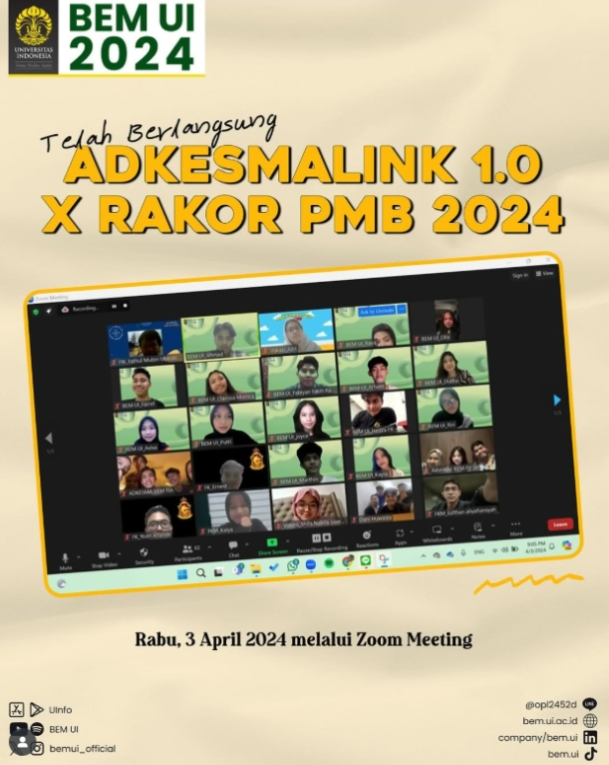
On April 3, 2024, the Adkesmalink 1.0 x PMB 2024 Coordination Meeting (on Freshmen Admission) was successfully conducted online via Zoom meeting. This forum served as a crucial platform for the internal coordination of the student executive bodies concerning student welfare and advocacy. The agenda focused on establishing working relationships, beginning with the introduction between the Student Executive Board Universitas Indonesia (BEM UI) Adkesma Functionaries and the Adkesma Departments of all faculty-level BEMs across UI. Following this, the forum proceeded with the introduction of BEM UI Adkesma’s work programs and a presentation of key issues highlighted by the BEM UI Adkesma Department. Crucially, the meeting concluded with a discussion of the strategic plan of the Adkesma Departments across all BEMs regarding the pressing issues of education fees and sexual violence, signifying a coordinated effort to address major challenges faced by the student body.

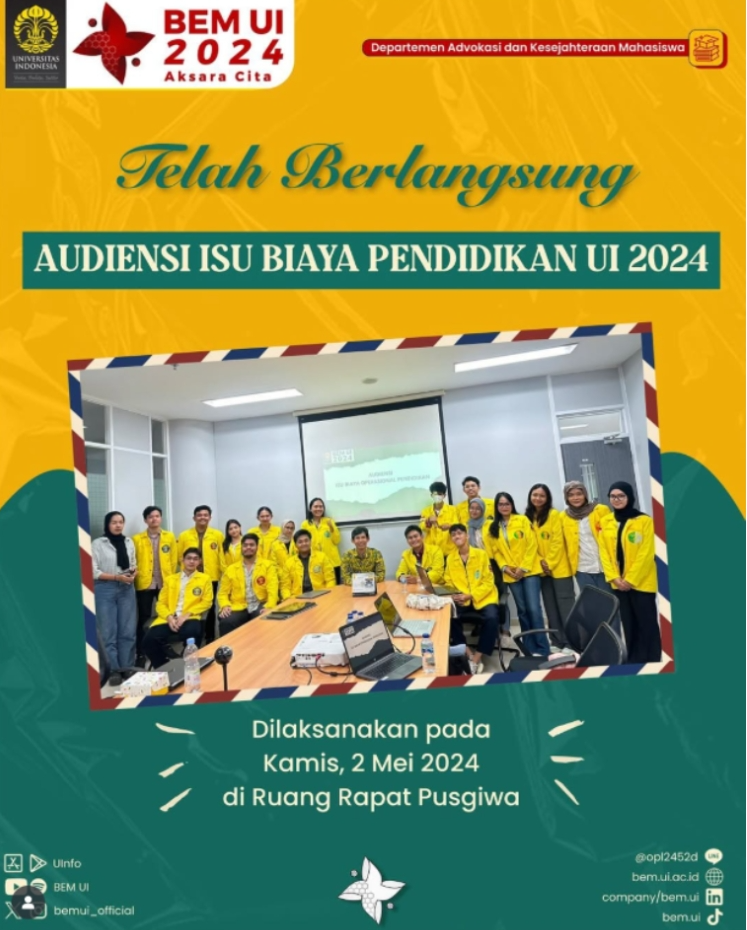
On May 2, 2024, an audience was held regarding the issue of education fees with the Alliance of Adkesma BEMs across UI. This audience is expected to provide appropriate policy recommendations that can have a broad impact on the entire UI Student Family (IKM UI) in the future. This event in particular is another proof of BEM UI’s role not only in advocacy as student support, but also governance input to university.

Adkesmalink 1.0 x Rakor PMB 2024
Discussion on tuition fee policies

BEM UI Supports Academic and Professional Student Life Through Social Activities

BEM UI also has the Student Empowerment and Innovation Department (PIM) which serves as a pioneer platform for students regarding career preparation, the business world, and the development of soft skills & hard skills. This department focuses on providing innovative and holistic solutions for the post-campus life of IKM UI and the wider community. Its main programs are empowerment platforms such as Innovation War, Career Talk, INNOVARE UI, COOLYEAH UI, and Career Net.

The ‘Grand Opening’ of Career Net was held offline on April 30, 2024. This event focused on strengthening career development efforts across the university, with an agenda that included the presentation of career development work programs from all Faculty Student Executive Boards (BEM) across Universitas Indonesia, the introduction of BEM work programs to all functionaries to facilitate better collaboration, and a discussion of the strategic plan for optimizing the performance of the various career development departments. 

Furthermore, BEM UI actively organizes social activities that strengthen interaction within the academic community, such as sports festivals, arts, and volunteer activities. This is primarily done through the Social and Community Department (DSM), which is the embodiment of the Tri Dharma of higher education, namely community service. Its work programs include Gerakan UI Mengajar (GUIM) (UI Teaching Movement), UI For the Surrounding (UIUS), UI Cares (UI Peduli), and Urban Community Review.

The 14th cohort of the UI Teaching Movement (GUIM) officially launched its series of community service activities in September 2024 with the theme ‘Moving, Sharing Inspiration,’ an initiative focused on improving basic education amidst regional disparities, particularly in the fields of Science and Technology (IPTEK) and language. GUIM 14 dispatched more than 100 UI student volunteers to 6 primary school locations scattered across Blora Regency, Central Java, with a total service duration of 30 days. The activity was welcomed and fully supported by the local Regional Government, and BEM UI hopes that this initiative will not only serve as the embodiment of the Tri Dharma of Higher Education (community service) but also become a spark of inspiration for students, parents, and the Blora community to jointly build better and sustainable educational quality, and strengthen collaboration between the university and the regional government in regional development.

BEM UI also acts as an environmental movement catalyst through the Environmental Department (DLH) by mainstreaming issues, advocacy, and facilitating innovation to address environmental challenges at the campus, national, and global levels. The main work programs of DLH include: Environmental Review and Advocacy, Greener Action, UI SDG Summit, Jakarta Sadar Sampah X BEM UI 2024 (Jakarta Waste Aware X BEM UI 2024), Green Rangers, and the 13th UI Youth Environmental Action.

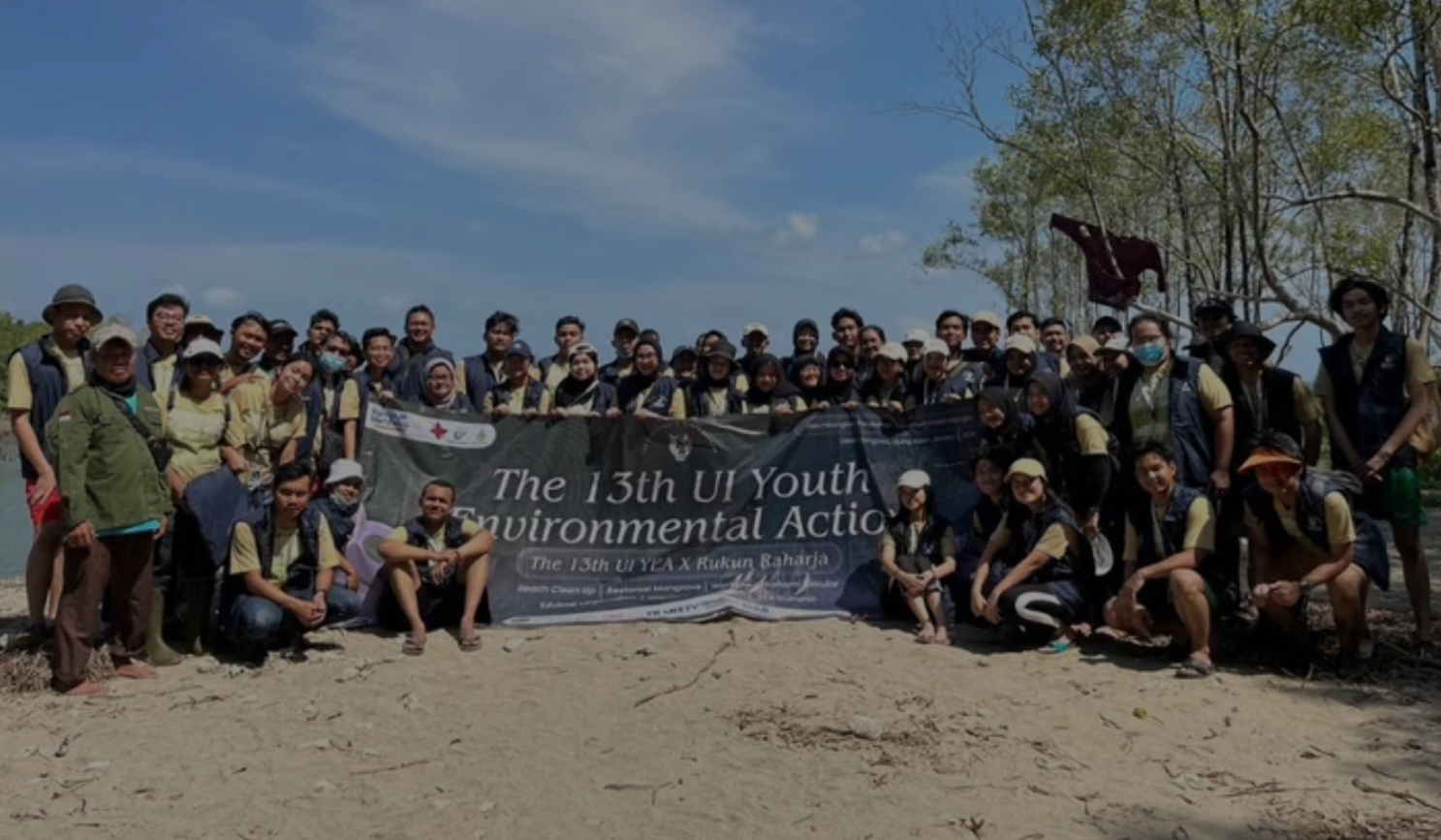
The 13th UI Youth Environmental Action (UI YEA 13) is a major student social activity organized by the Environmental Department (DLH) of BEM UI 2024, serving as a tangible manifestation of community service and the promotion of proactive social activities. In collaboration with PT Rukun Raharja Tbk, the program was executed over 10 days, from May 21 to 30, 2024, in Ujung Jaya Village, Ujung Kulon, Banten, under the theme ‘Waving Change, Anchoring Balance.’ The activities were aimed at raising community awareness and participation in achieving the Sustainable Development Goals (SDGs), particularly those related to quality education, responsible consumption and production, climate action, and life below water. The YEA 13 program series included a Clean Up (beach cleaning), Mangrove Restoration with the planting of 1,000 seedlings, a Circular Economy Workshop targeting women’s empowerment, environmental education in primary schools, and the construction and repair of facilities in two primary schools within the area, making it strong evidence of impactful social activity execution.

Universitas Indonesia Strengthens Role as Government Partner in National and Regional Research and Policy Consultation

Throughout 2024, Universitas Indonesia (UI) demonstrated our active role in providing policy advice and scientific expertise (expert advice) to various levels of government, from national to provincial, and local, through policy research, educational collaborations, and public governance assistance.

On November 7, 2024, UI submitted 30 policy briefs derived from its research to the IKN Authority (Otorita Ibu Kota Nusantara) in Jakarta. These policy briefs contain research-based policy recommendations across four main clusters: energy, social and humanities, environmental conservation, and technology and informatics. This submission serves as UI’s academic contribution to the formulation of evidence-based national development directions.

UI submitted a policy brief containing policy recommendations for the development of IKN Nusantara, focusing on four main clusters

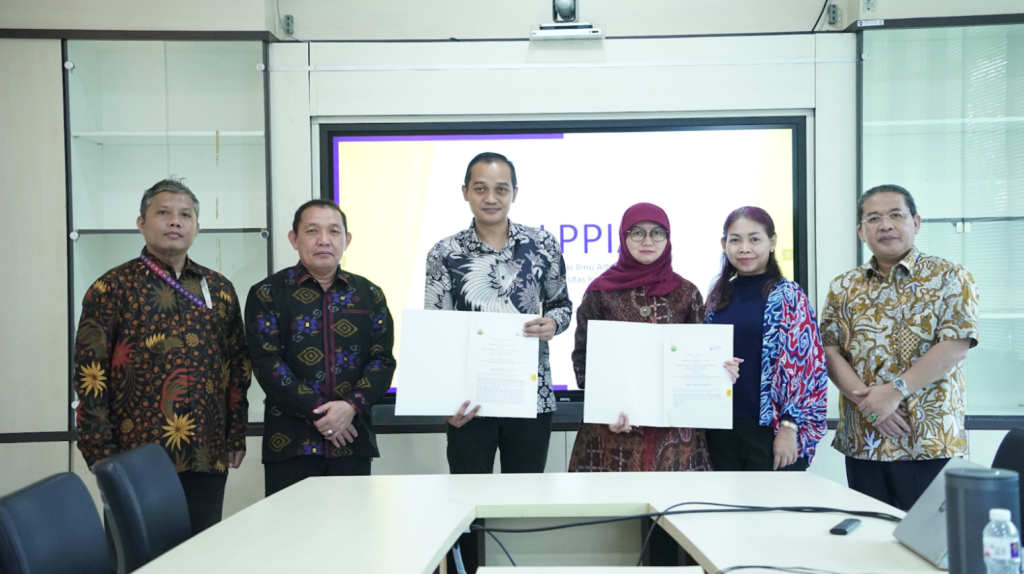
Subsequently, on December 5, 2024, UI and the Riau Provincial Government signed a Joint Agreement (Kesepakatan Bersama) concerning Education, Research, Development, and Community Service aimed at Regional Development of Riau Province. This agreement serves as the foundation for policy research collaboration and institutional capacity strengthening between UI and the provincial/regional government.

Earlier, on January 19, 2024, UI’s Faculty of Administrative Sciences (FIA UI) established cooperation with the Tidore Islands Municipal Government in the field of postgraduate education for civil servants (ASN). This collaboration aims to enhance the capacity of local officials in public administration management based on scientific knowledge.

Cooperation Agreement signing for the Master’s Program in Public Administration and Policy between FIA UI and the Tidore Islands Municipal Government

Then, on June 25, 2024, FIA UI signed a Cooperation Agreement (PKS) with the Buol Regency Government, Central Sulawesi. This cooperation covers policy formulation and the strengthening of local governance through training and research-based consultation.

PKS signing between FIA UI and Buol Regency Government, Central Sulawesi

Through these various collaborations, Universitas Indonesia demonstrates a concrete commitment to Provide Expert Advice to the Government. This public evidence illustrates UI’s direct involvement in the formulation and strengthening of research-based public policy at the national, provincial, and local levels, simultaneously affirming UI’s position as a strategic government partner towards scientific and sustainable development governance.