
Universitas Indonesia Strengthens Environmental Sustainability Knowledge Through Training
Year after year, Universitas Indonesia (UI) consistently conducts training on various aspects of environmental sustainability for both staff and students. UI’s training programs are managed both under the university’s Administration Center and individual faculties, often under the Health, Safety, and Environment (HSE) unit. These programs are designed to advance understanding and implementation of sustainable practices that align with UI’s goals and values. Throughout 2025, UI’s HSE unit has conducted the following trainings:
- Commemoration Webinar for the International Day for Biological Diversity
- Laboratory HSE Implementation Workshop
- Fire Extinguishing Training with Hydrants
- Earthquake, Fire, and Fire Extinguishing Training with Fire Extinguishers
- Fire Fighting and Fire Extinguishing Training with Fire Extinguishers
- Building Fire Protection System Inspection Training
- Basic First Aid Training
- Laboratory Chemical Spill Handling Training
- Disaster Management Training
- Emergency Simulation Training
- Vertical Rescue Training
- Workshop on Responsive, Agile, and Resilience Emergency Response
- Building Fire Safety and Prevention Workshop
Most of these trainings were attended by both staff and students while others were designated for staff. In order to improve reach and impact, these training programs are often conducted in partnership with various relevant entities. One notable event was our collaboration with Depok’s Environmental and City Services (DLHK) through UI’s Makara Satellite Clinic on Emergency Response Training for Hazardous and Toxic Waste Management.

Faculties at UI also conduct their own environmental sustainability training programs. The following are training programs conducted by faculties throughout 2025:
- Biorisk Management: Implementation of Biosafety and Biosecurity at the Faculty of Medicine

- Plastic Bottle Waste Management Socialization at the Faculty of Pharmacy, in collaboration with UI’s Center for Sustainability and Waste Management (CSWM UI). This event was conducted as a follow up to the placement of plastic bottle waste dropboxes in faculties in order to inform staff on the mechanisms for plastic bottle waste management, collection procedures, and the faculty’s waste management data reporting system which will be integrated into UI’s’ campus waste management system.
- Disaster Response Training (Earthquake Simulation and Use of Light Fire Extinguisher) at the Faculty of Nursing.
- Inhouse Training on Hazard Identification Assessment of Risk and Opportunity (HIARO) at the Faculty of Engineering. The HIARO Training was held to improve the competencies of laboratory technicians at the Faculty of Engineering in risk management, laboratory safety, and handling human interactions in technical and operational laboratory systems.

- First Aid and Basic Life Support Training, as well as Emergency Response Training at the Faculty of Mathematics and Natural Sciences.
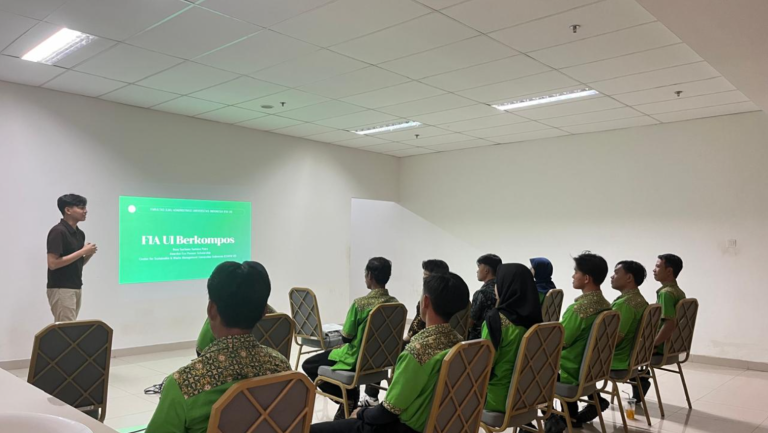
- Organic Food Waste Management Training for staff and cleaning personnel at the Faculty of Administrative Sciences.
- Workshop on reusing plastic waste for vertical gardens for new students at the Vocational Education Program. This workshop was mandatory for all freshmen at the Vocational Education Program as part of their orientation.

How Universitas Indonesia Assesses Sustainability Literacy and Knowledge
At Universitas Indonesia, sustainability knowledge and literacy are primarily evaluated through coursework. In non-STEM programs, faculties rely on information literacy tools, many of which integrate sustainability indicators, to gauge students’ understanding, embedding these tools into class assignments. In contrast, most STEM programs treat sustainability literacy as a central component of their curriculum, making it a core element of subject assessments. Additionally, some faculties have started designing instruments to measure sustainability literacy among staff members.
As a pioneer in this aspect at UI, the Faculty of Mathematics and Natural Sciences has developed a Sustainability Literacy Test instrument for students and staff to measure students’ knowledge, attitudes, and behaviors regarding sustainable development issues. This instrument is administered online and analyzed in the form of a sustainability literacy index as a basis for evaluation and faculty policy development.
In 2025, UI’s Graduate School for Sustainable Development conducted a Planetary Carbon Certification Program. While this program was open to the public, it was part of the mandatory classes for students taking the Environmental Science course at the Graduate School for Sustainable Development. Through this program, participants are equipped with knowledge regarding carbon trading mechanisms, environmental regulations, and best practices in carbon emission mitigation, as well as tested as a prerequisite for certification.
Sustainability Policies at Universitas Indonesia
In 2011, UI formally addressed the issue of climate change through UI’s Rectoral Decree 1307/SK/R/UI/2011 on the Policy on Mitigation and Adaptation to Global Climate Change. This commitment was then reaffirmed and updated in 2024 through UI’s Rectoral Decree No. 440/SK/R/UI/2024. In 2018, UI launched the Green Campus Initiative through UI’s Rectoral Decree 2893/SK/R2018 on UI Green Campus Policy, which officially marked our commitment towards sustainability. Through this decree, UI designated UI GreenMetric (UIGM) as one of the key performance indicators of sustainability on campus.
Beyond these measures, UI has implemented additional policies and initiatives to reinforce our sustainability agenda. This includes establishing policies concerning sustainable investment and sustainable procurement of goods and inventory on campus. A few other notable and currently active policies governing sustainability on campus are as follows:
Environmental Sustainability Policies:
- UI Rectoral Decree No. 1212/SK/R/UI/2024 on the Energy Conservation Policy
- UI Rectoral Decree No. 1213/SK/R/UI/2024 on the Policy on Management of Garbage and Waste Containing Hazardous and Toxic Materials
- UI Rectoral Decree No. 1214/SK/R/UI/2024 on the Policy on Transportation in Universitas Indonesia
- UI Rectoral Decree No. 1215/SK/R/UI/2024 on the Clean Water Conservation Policy
- UI Rectoral Decree No. 1805/SK/R/UI/2011 on the Smoke-Free Campus Area
- UI Rectoral Decree No. 437/SK/R/UI/2024 on Reduced Paper usage on Campus
- UI Rectoral Decree No. 438/SK/R/UI/2024 on Universitas Indonesia as a Sustainable Green Campus
- UI Rectoral Decree No. 439/SK/R/UI2024 on Restrictions on Food and Beverage Packaging Containing Hazardous and Toxic Materials on Campus
As of 2025, UI has managed to collect IDR 235 billion (approximately USD 13.726.350) in our Endowment Fund and is targeted to reach IDR 1 trillion (approximately USD 58.410.000) by 2029. This target is shared across all 16 faculties at UI. In order to support the realization of this target, UI has established the following policies in sustainable investment:
- Board of Trustees Regulation No. 004 of 2025 on the UI Endowment Fund (Article 9)
- Rectoral Regulation No. 41 of 2025 on UI Fund Investment Governance (Articles 7 & 8)
As of 2025, the Directorate for Procurement of Goods and Services are in the works of renewing the UI Rectoral Decree No. 11 of 2025 for 2026.
How Our Students Engage with Sustainability
In addition to these programs, many, if not all, Student Associations in all faculties actively engage in sustainability through facilitating fundraising for disaster relief as well as educating fellow students on sustainability through events and social media campaigns.
As a higher education institution, UI carries the responsibility of making a positive contribution to society. This responsibility also extends to our students, who are expected to apply their knowledge and research skills in ways that benefit communities. UI actively encourages our students to engage with surrounding communities and beyond to foster meaningful impact through community service initiatives.
UI’s Students’ Association has a department dedicated to environmental affairs called the Department of Environment (DLH BEM UI). This department conducts various events, programs, and activities revolving around the realization of the SDGs. In addition to their own events, UI’s Students’ Association also coordinates students in participating in sustainability action activities conducted under the Directorate for Community Service and Social Innovation, as well as the Directorate for Campus Welfare. Several events operating under DLH BEM UI are as follows:
- UI Youth Environmental Action, which was conducted in collaboration with SustainaBlue and UI’s Directorate for Community Service and Social Innovation in 2025
- UI SDGs Summit, an International Summit on Sustainable Development Goals
- Ciliwung Beraksi which is conducted in collaboration with UI’s Directorate for Community Service and Social Innovation
- Eco Impact UI which is also conducted in collaboration with UI’s Directorate for Community Service and Social Innovation
- Green Rangers UI which is a platform for volunteers to contribute towards climate issues
- Jakarta Sadar Sampah x BEM UI
At UI, several faculties have established student-led societies for the purpose of engaging with sustainability. Most of these societies operate as and/or under Students’ Associations as work programs. For example, students at the Faculty of Economics and Business have a student-led society called HUMUS. HUMUS is a student organization dedicated to not only exploring but also caring for the environment. Routine activities at HUMUS include basic physical and technical training, theoretical knowledge of nature, environmental studies from an economic perspective, and wilderness exploration. The Faculty of Administrative Sciences’ Students’ Association also has a Department of Social and Environmental Affairs.
Students at the Faculty of Public Health also have a student society based in the Department of Environmental Health called the Environmental Health Student Association (ENVIHSA). ENVIHSA’s work spans across raising awareness of environmental issues among Environmental Health students by responding to issues through various campaigns as well as issuing scientific papers.
The following programs are also examples of how our students work together to engage with sustainability:
- Rumah Peduli Iklim by the Department of Social and Environmental Affairs of the Faculty of Mathematics and Natural Sciences’ Student Association. Rumah Peduli Iklim aims to build awareness, concern, and collaborative relationships with others regarding the climate crisis by providing educational and proactive programs; encouraging transformative innovation and development, as well as concrete, sustainable solutions to waste, energy, and climate issues.
- Kimia Tanggap Lingkungan (KATALIS) by the Chemistry Department’s Student Association at the Faculty of Mathematics and Natural Sciences. This event aims to build public awareness of the environment by providing education related to environmental issues, providing a collaborative platform for the general public to contribute to social activities related to the environment, and inspiring all groups to participate in creating changes that have a positive impact on environmental sustainability.
- Teknik Turun untuk Bumi (TekTukBum) by the Department of Environment of the Faculty of Engineering’s Student Association. This program has the aim of increasing awareness regarding environmental issues and initiating an environmental action movement for students in the Faculty of Engineering, instilling the importance of sustainable environmental preservation. On June 17, 2025, TekTukBum together with 60 student volunteers from the Faculty of Engineering collaborated in planting 500 mangrove seedlings in Lontar Village, Banten.
- MIPA Green Village (MGV) by the Department of Social and Environmental Affairs of the Faculty of Mathematics and Natural Sciences’ Student Association. In its 11th edition in 2025, MGV aimed to strengthen collaboration between students and the community of Cibedug Village by integrating local resource-based events, revitalizing water access through sustainable energy solutions, providing interactive environmental learning for elementary students, and offering health services and education. Click here for more information on the activities of MGV 11.
Carbon Reduction Roadmap: Net Zero by 2045
UI has publicly committed to achieving net zero emissions by 2045, setting a clear carbon reduction target that covers Scope 1 and Scope 2 emissions. This commitment is structured around three progressive phases:
- Laying the foundation for transformation by 2030 through carbon inventories, energy efficiency, and renewable energy adoption.
- Accelerating the energy transition throughout 2030-2040 with deeper emission cuts and clean energy integration.
- Reaching full neutralization by 2045 through advanced technologies and nature-based solutions.
2025-2030
Foundational Transformation
- Regular and comprehensive carbon footprint inventory and reporting
- Reducing emissions by at least 30% through energy efficiency and integrated waste management
- Expanding the use of renewable energy on campus
- Strengthening low-carbon technology research and innovation
- Implementing green buildings and low-carbon transportation systems
2030-2040
Energy Transition Acceleration
- Emission reductions of up to 60-75%
- Significant transition to renewable energy
- Strengthening research and innovation in clean energy and the circular economy
2040-2045
Neutralization and Global Leadership
- Optimizing efficiency, electrification, and renewable energy systems
- Neutralizing remaining emissions through nature-based solutions and technological innovation
- Achieving 100% Net Zero Emissions by 2045
By establishing this timeline, we demonstrate that our net zero pledge is anchored in measurable milestones that ensure accountability in our journey towards a sustainable existence. Our moving target of 2045 reflects Indonesia’s national priorities as well as our role as a leader in sustainability in higher education.