Our actions and goals
Click the SDG Goals to read the initiatives

SDG 6: Clean Water and Sanitation
Ensure availability and sustainable management of water and sanitation for all
Enhancing Clean Water Management on Campus, UI Maintains Sustainable PDAM Water Consumption in 2025
Universitas Indonesia (UI) continues to reinforce our commitment to environmental sustainability through active monitoring and efficient management of clean water consumption across all campus facilities. Based on the recapitulation report of treated water supplied by the Regional Water Utility Company (PDAM), UI recorded a total water consumption volume of 280,933 m³ in 2025.
The utilization of PDAM treated water across UI campuses ensures a hygienic, quality-tested, and safe water supply for the entire academic community. The distribution coverage encompasses all operational areas, including faculties, schools, the vocational education program, administrative buildings, and public campus spaces.
Recapitulation of Treated PDAM Water Consumption
As part of our commitment to transparent resource management, UI regularly records monthly clean water usage. Below is the summary of PDAM water consumption across UI campuses from 2023 to 2025:
Water Consumption in 2023
Water Consumption in 2024
Water Consumption in 2025
The volume of water used across the campus changes significantly over the years. These figures are attributed to several key operational factors:
- Return of Student Population to Campus
In 2023, approximately 50% of junior and sophomore bachelor students participated in national and international mobility programs (exchanges, internships, etc.) that required off-campus activity. In 2024, many of these programs concluded, leading to a full resumption of student activities on campus. - Campus Population Growth and Re-opened Facilities
The campus population shows significant growth over the years, resulting in more water consumption across campus. Furthermore, several campus canteens and public facilities resumed operations after finalizing vendor selection processes following the return of offline campus activities in 2024. In 2025, UI welcomed a variety of new tenants which contributes towards the rise of water consumption as well. - New Building Developments and Infrastructure Expansion
Numerous grants enabled the completion and operation of several EDGE-certified buildings, including the Interdisciplinary Engineering (IDE) Building at the Faculty of Engineering (8 floors), the Interdisciplinary Legal Research Center (ILRC) Building at the Faculty of Law (9 floors), the new Faculty of Administrative Sciences Building (9 floors) Building, as well as the ongoing Science Techno Park UI (8 floors) and new facilities at the Faculty of Computer Sciences.
Water Conservation and Efficiency Initiatives at UI
Reflecting on the water usage surge between 2023 to 2024, UI recognizes the need to manage water consumption growth alongside infrastructure expansion. Therefore, UI introduced several targeted efficiency measures in 2025 to ensure water consumption does not show an unusual increase in proportion to developments and builds on campus, among others:
- Installation of Water-Saving Fixtures: Sensor-activated faucets and high-efficiency dual-flush toilets retrofitted across faculties.


- Rainwater Harvesting and Greywater Recycling: Non-potable demands such as campus landscape irrigation were increasingly met using stored rainwater and treated greywater.

- Cultivation of Water Conservation Culture: Active awareness campaigns encouraging responsible water habits in laboratories, cafeterias, and recreational facilities.

Through integrated measurement and sustainable management, UI continues to advance SDG 6: Clean Water and Sanitation.
UI Strengthens Campus-Wide Wastewater Treatment Infrastructure and Annual Water Reuse Monitoring
UI recognizes clean water as a fundamental need and is committed to preventing water pollution through our Clean Water Conservation Policy, established under Rector’s Decree No. 1215/SK/R/UI/2024. The policy outlines measures to monitor water quality, control pollution, and maintain water quality through appropriate wastewater treatment technologies.
Keputusan Rektor Universitas Indonesia No. 1215 Tahun 2024, Poin 5
“Melakukan pemantauan dan pemeriksaan kondisi kualitas air, baik permukaan, air bersih maupun air yang digunakan untuk konsumsi secara berkala di lingkungan Universitas Indonesia”
Keputusan Rektor Universitas Indonesia No. 1215 Tahun 2024, Poin 8
“Mendorong pengendalian pencemaran dan pemeliharaan kualitas air dengan penerapan teknologi khusus pengolahan limbah cair yang dihasilkan oleh aktivitas terkait tugas fungsi pokok pendidikan maupun limbah rumah tangga”
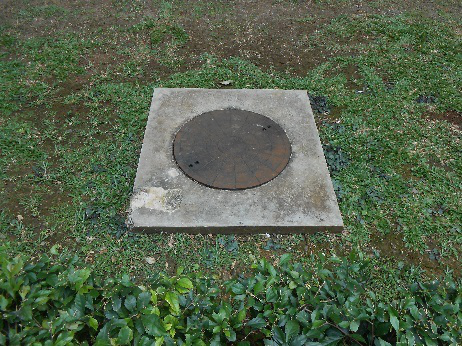
To implement this regulation, UI’s efforts to prevent polluted water from entering the wider water system are centered on decentralized STPs located at faculties and units. Waste streams from toilets, sinks, and laboratories are routed to dedicated treatment tanks where domestic wastewater is continuously treated until it meets discharge or reuse standards; laboratory effluents receive pH neutralization before entering the treatment train to avoid chemical shocks to downstream systems. The campus also captures ablution runoff and harvested rainwater into ground tanks so these flows are controlled and managed rather than discharged untreated into drain.
UI complements on-site treatment with a reliance on hygienically managed municipal supply for potable uses and careful allocation of treated water for nonpotable applications, reducing pressure to discharge raw or marginal-quality water and protecting public health on campus. By maintaining clear separation between potable PDAM supply and treated/reused waters, UI minimizes the risk that contaminated or inadequately treated water reaches drinking supplies or public conveyances.


Quantitative Measurement and Institutional Oversight of Water Usage and Reuse at UI
A critical pillar of UI’s sustainable water governance is the continuous verification of system performance. UI’s Directorate for Operations, Facility Maintenance, and Asset Management (DOPFMA) measures and audits total volume metrics for wastewater treatment and recycled water reuse on an annual basis. Other than becoming a form of accountability, measurement and audit of water reuse also helps quantify and further develop a reduction of reliance on raw water extraction.
Through dual tracking of PDAM water usage and recycled water reuse, UI quantifies the exact volumes of treated water safely redirected to non-potable campus operations—such as toilet flushing, vehicle washing, and landscape irrigation; as well as clean water for potable uses in order to demonstrate a fully verified, data-driven approach to sustainable water management. This auditing process ensures continuous system upkeep, verifies compliance with national environmental standards, and systematically lowers raw water intake and overall environmental discharge under SDG 6 (Clean Water and Sanitation).
Provision of Free Drinking Water at UI
UI provides drinking fountain facilities at various locations, including the University Administration Center Lobby, UI Mosque, New Student Activity Center (Pusgiwa), the UI Library, dormitories, the Stadium Hall, Gymnasium, Sports and Recreation Center (SOR), the security post at Universitas Indonesia Station, and buildings across all faculties. These facilities are available to students, lecturers, staff, and visitors. Through provision of free drinking fountains across campus, anyone can meet their drinking water needs by bringing their own reusable water containers, thereby helping reduce plastic packaging waste from disposable plastic water bottles as well. Drinking fountains at UI are equipped with the ability to filter solid particles, chemical substances, and microorganisms from water sourced from the municipal water supply or wells.

UI Enforces Water-Efficient Building Standards to Advance Sustainable Water Management
UI strives to maintain our position as an internationally recognized sustainable campus by enforcing campus-wide, measurable, and certified water-efficient building standards. This strategic effort actively supports the SDGs, particularly SDG 6 (Clean Water and Sanitation) and SDG 11 (Sustainable Cities and Communities).
UI’s institutional commitment to water resource efficiency and environmental governance is anchored in the UI Rector’s Decree No. 438 of 2024 on the UI Green Campus. This policy mandates that all campus facility designs, construction projects, and operational activities incorporate strict water conservation practices, resource optimization, and green building principles. This decree builds on an older regulation, the UI Rector’s Decree No. 2446 of 2016 on the Depok Campus Master Plan (2016–2026), which outlines sustainability as one of the core values UI abides by in campus development. This value extends to water management, where new buildings at UI are obligated to be designed with measures to minimize water usage and older buildings are continuously having conventional water appliances replaced with water-efficient variants.
Additionally, several buildings at UI have gone the extra mile to achieve the EDGE Green Building Certification, where one of their main criteria for a building to be certified is to demonstrate a significant amount of water savings. As of 2025, UI has 4 EDGE-certified buildings with another one in the process of becoming certified.
Green Buildings and Planting Landscapes to Minimize Water Usage
Green Building Concept for Water Savings
UI applies the green building concept to the UI Library, in line with UI Rector’s Decree No. 2446 of 2016 on the Depok Campus Master Plan (2016–2026). Through the application of passive cooling design and zero-waste water principles, the UI Library is equipped with a large-capacity rainwater storage system integrated into the building’s design. The collected rainwater is used for sanitation and landscape irrigation, reducing dependence on municipal water supplies (PDAM) by up to 35%.
Wastewater from daily activities is treated through natural biofiltration using a water garden that serves as both a purification system and an aesthetic feature. This system creates a closed-loop water cycle that helps preserve groundwater in the campus area while providing a visually refreshing environment for visitors. In addition, the rooftop grass landscape functions as a natural stormwater management system. It slows down and filters runoff before directing it to a large-capacity rainwater harvesting system beneath the building, where the collected water is reused for plant irrigation and sanitation

Hydroponics to Minimize Water Usage
As a green campus, UI adopts water-efficient planting methods through hydroponic cultivation to minimise water consumption. Hydroponics is a soilless cultivation technique that uses nutrient-rich water circulated through a controlled, closed-loop system, making it more water-efficient. Hydroponic gardens have been established at the University Administration Center and each faculty to enhance food security while also reducing environmental impacts by minimizing water usage.

Drought-Tolerant Plants for a Water-Efficient Landscape
In addition to the aforementioned initiatives, UI also ensures the majority of trees and plants at UI are drought-tolerant in order to minimize water usage. This includes plants and trees such as baobab, tabebuia, frangipani, and hibiscus or at the very least moderately drought-tolerant such as starfruit trees and matoa trees. The following are several drought-tolerant plants as seen in UI’s Depok Campus:


Policies on Maximizing Water Reuse at UI
UI recognizes clean water as a fundamental need and a finite resource. To conserve water and support campus operations, UI has adopted a policy regulating water reuse under the UI Rector’s Decree No. 1215 of 2024, which promotes recycling and rainwater harvesting for non‑potable uses across campus. This is particularly addressed in point 4 of the regulation which details UI’s commitment to recycling and reusing water for various non-potable uses.
Our wastewater management is centered on decentralized STPs located at faculties and units. Domestic wastewater from toilets, kitchen sinks, and neutralized laboratory effluents is treated until it meets standards for safe discharge or onsite reuse. In addition, ablution (wudhu) wastewater and harvested rainwater are collected in ground tanks for reuse. Treated and harvested water is reused for toilet flushing, washing official vehicles and operational equipment, and irrigating campus landscaping.
Keputusan Rektor Universitas Indonesia No. 1215 Tahun 2024, Poin 4
“Mendorong pemanfaatan daur ulang air seperti pemanfaatan kembali air hujan (sistem panen air hujan) untuk keperluan rumah tangga, untuk flush di toilet, pencucian kendaraan dinas dan operasional, dan menyiram tanaman.”
To maintain policy relevance and adapt to contemporary environmental challenges, the enactment of the UI Rector’s Decree No. 1215 of 2024 officially repeals and replaces the earlier policy framework, the UI Rector’s Decree No. 1309 of 2011 concerning Clean Water Conservation Policy at UI. This statutory update strengthens our governance framework by modernizing technical standards for campus-wide water reuse, expanding decentralized greywater treatment targets, and reinforcing mandatory rainwater harvesting protocols across all academic and operational facilities.
UI Provides Educational Opportunities and Water Conservation Support Off Campus
UI conducts water conservation initiatives beyond campus through community service programs that promote sustainable water management. These programs include educational opportunities for local communities as well as constructing or supporting the construction of infrastructure for water conservation off campus.
Community Education & Infrastructure Development: FKM UI Collaborates with Menabung Air for Education on Water Conservation and Biopore Construction
To raise public awareness of the importance of water conservation, UI’s Faculty of Public Health (FKM) collaborated with the Menabung Air Foundation in FKM UI Peduli 21 which is an educational and concrete action program in Lebak Parahiang Village, Banten. This activity focused on two main areas: water conservation education and the construction of biopore infiltration holes in the community. The series of activities began with an educational session on the water crisis and biopore solutions as a simple yet effective infiltration method. Afterward, residents were invited to participate directly in the practice of creating and planting biopore holes around their homes. A total of 100 biopore holes were successfully planted, reaching over 200 residents in this interactive and participatory hands-on education session.

Community Education: SPPB UI Collaborates Local Government for Rainwater Harvesting Training at Muaragembong
UI provided educational opportunities for local communities through a community service program in Muaragembong District, Bekasi Regency, on 14 September 2025. In collaboration with the Muaragembong District Government, UI academics from the School of Environmental Science (now the Graduate School of Sustainable Development) delivered practical training on rainwater harvesting as a sustainable source of clean water, the proper management of domestic and vessel wastewater, and tidal flood mitigation. The program aimed to strengthen community awareness and capacity to manage water resources independently and sustainably, while addressing clean water shortages in coastal areas.

Community Education & Infrastructure Development: UI Collaborates with PT KAI for Rainwater Harvesting System in Grobogan Regency
On 24 July 2025, UI collaborated with PT Kereta Api Indonesia (KAI) to deliver rainwater harvesting education and training in Depok and Kradenan villages, Grobogan Regency, Central Java. The programme provided hands-on training for local communities on rainwater harvesting techniques, hygienic water storage, and the use of harvested rainwater for household and agricultural needs. UI also constructed a Rainwater Harvesting System (SPAH) by installing three water tanks, each with a capacity of 6,000 litres, to help address seasonal water shortages and improve access to clean water.

Infrastructure Development: UI Collaborates with Universities for Clean Water Technologies at Belu Regency
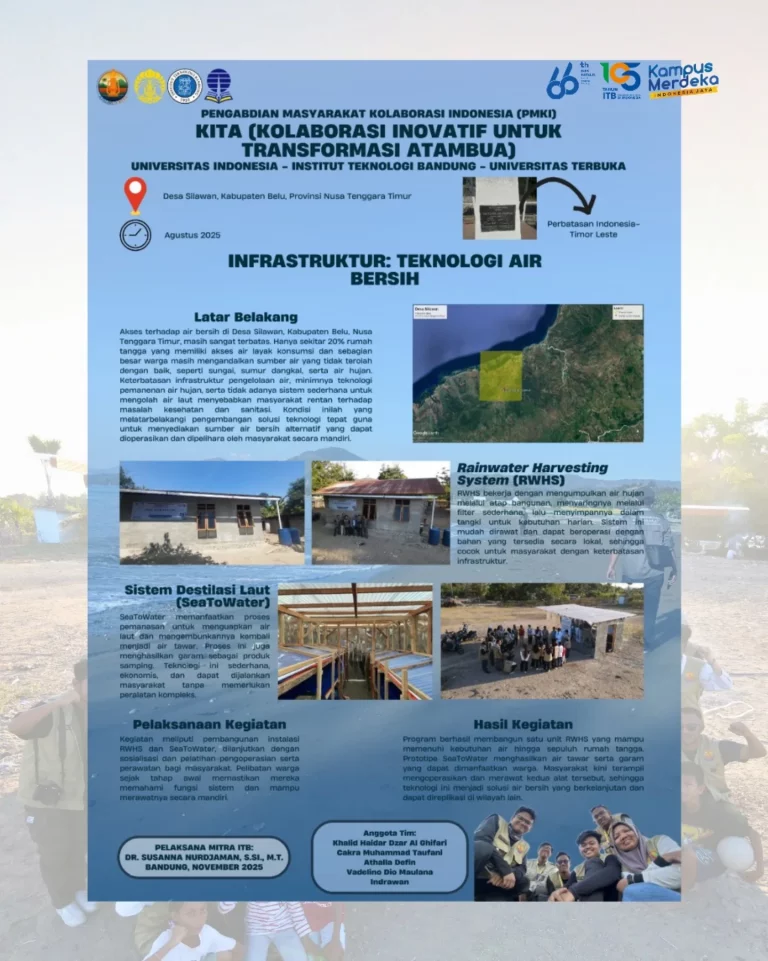
2025 marks the third year of UI’s participation in Atambua KITA (Intensive Collaboration for Joint Transformation) community service programme in Silawan Village, East Tasifeto District, Belu Regency. This program is a collaboration between UI, Institut Teknologi Bandung (ITB), and Universitas Terbuka (UT) under the Indonesian Collaborative Community Service Programme (PMKI), supported by the Directorate General of Higher Education under the Ministry of Higher Education, Science, and Technology. Conducted from 9 to 24 August 2025, the programme aimed to create a sustainable impact on communities in the Indonesia–Timor-Leste border region.
UI helped develop infrastructure, including a salt production facility and a rainwater harvesting system designed to collect and utilise rainwater efficiently and sustainably, with an operational approach suited to community needs. This initiative aims to address the community’s need for a sustainable source of clean water.
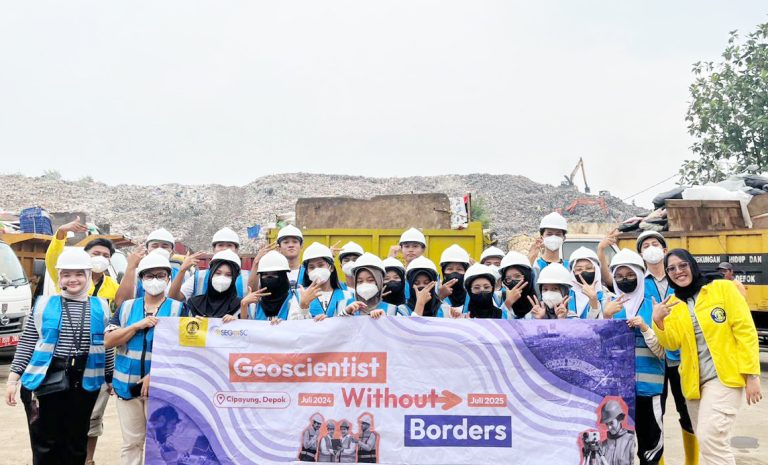
Infrastructure Development: FMIPA UI Installs Water Filters at Cipayung through the Geoscientist Without Borders Program
In July 2025, students from UI’s Faculty of Mathematics and Natural Sciences (FMIPA) through the SEG UI Student Chapter, initiated efforts to address groundwater quality issues in Cipayung District, Depok. Geochemical analyses were also conducted on 20 groundwater samples collected from residents’ homes, of which 13 were found unsuitable for consumption based on applicable water quality standards. As an initial intervention, the team installed water filters in the homes of affected residents to help mitigate health risks.
Community Education & Infrastructure Development: FKM UI Educates and Installs Biopores in Tanah Sareal to Improve Water Absorption
In 11 November 2025, a lecturer from FKM UI conducted a community service programme in Tanah Sareal, Bogor, focusing on environmental sanitation and early diarrhoea prevention. The program included education and practical demonstrations on installing biopore infiltration holes, which help improve water absorption into the soil while supporting household organic waste management. Participants also received 20 biopore tubes and three biopore drilling tools to support the implementation of this practice in their neighbourhoods.

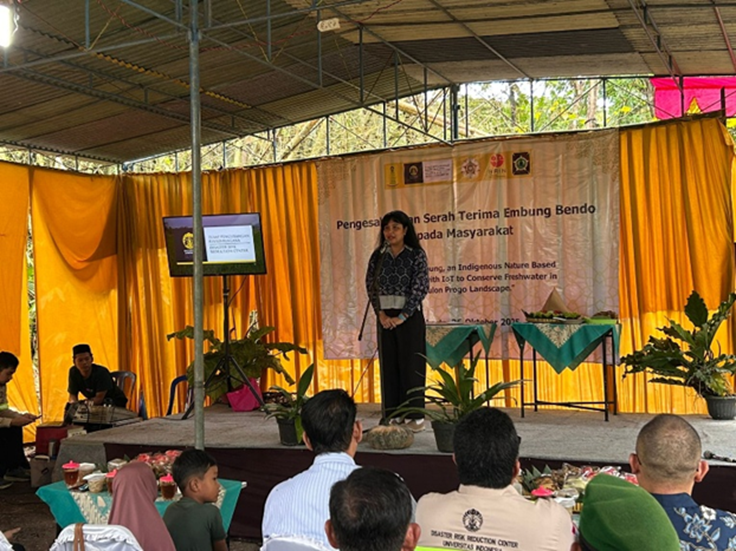
Infrastructure Development: DRRC UI Provides Integrated Agricultural Water Management System in Kulon Progo
UI’s Disaster Risk Reduction Center (DRRC), supported water conservation in Embung Bendo, Kulon Progo, Yogyakarta, through an integrated agricultural water management system combining a water storage reservoir, Internet of Things (IoT)-based monitoring devices, automatic water flow controls, and drip irrigation. The system regulates water distribution according to crop needs to minimise water waste. DRRC UI also provided training for local residents on operating and maintaining the technology to support more efficient and sustainable water management.
Sustainable Water Extraction Technologies at UI
UI combines on-site capture, reuse, and recharge to minimize reliance on external supplies while protecting local hydrology. Rainwater harvesting systems collect rooftop and paved runoff into tanks for non-potable uses, and treated ablution greywater is recycled for tasks like watering plants and washing vehicles. These measures reduce demand on municipal water and provide resilient sources for everyday campus needs.


To maintain and restore groundwater, UI also installs biopore holes and infiltration wells across green areas and drainage points. These features speed up stormwater infiltration, prevent surface flooding, and channel excess water back into shallow aquifers, helping stabilize local water tables. Regular monitoring and maintenance ensure recharge rates and water quality remain appropriate for their intended uses.

UI uses operational safeguards to prioritize health and impact reduction. Reused water is treated to match its end use, non-potable sources are used first, and groundwater withdrawals are controlled to avoid ecological harm. Together, these systems lower flood risk, support healthier landscapes, and serve as living demonstrations of sustainable water management for students, staff, and the surrounding community.
UI Engages in Cooperations on Water Security
UI supports water security through collaborations with research institutions, other universities, and local governments, combining scientific research, water resource planning, and community-based technological interventions to address water management challenges.
Collaboration with the National Research and Innovation Agency (BRIN)
On 17 June 2025, DRRC UI signed a cooperation agreement with the National Research and Innovation Agency (BRIN), specifically its Research Center for Limnology and Water Resources, to strengthen collaborative research and innovation in limnology and hydrology. Over an 18-month period, the collaboration focuses on developing an Internet of Things (IoT)-based freshwater conservation model in drought-prone areas of Bendo Hamlet, Ngentakrejo Village, Kulon Progo Regency, Yogyakarta. The planned activities include collaborative research, community training, and joint publications, supported by the rehabilitation of a water storage reservoir (embung), solar-powered drip irrigation, and soil moisture and weather sensors to improve water distribution efficiency. The initiative also involves local communities in managing the system, aiming to conserve water, support agricultural productivity, and strengthen local capacity.

Collaboration with the Jakarta Provincial Government
At the regional level, the Jakarta Provincial Water Resources Agency appointed the Technology Institute of UI’s Faculty of Engineering (Lemtek UI), to develop a water resource management framework using a Nature-Based Solutions (NBS) approach. Announced on 25 August 2025, the collaboration involved coordination and synchronisation with Institut Teknologi Bandung (ITB) to align policies, strategies, and technical standards for more measurable, effective, and climate-adaptive water management. The NBS approach integrates modern technology, infrastructure planning, and the restoration of natural ecosystems. The proposed infrastructure is intended not only to help control flooding but also to support environmental conservation and provide public spaces for recreation, sports, and social interaction. This collaboration contributes to regional water governance by incorporating nature-based approaches into Jakarta’s water management planning.

Collaboration with the Kulon Progo Regency Government
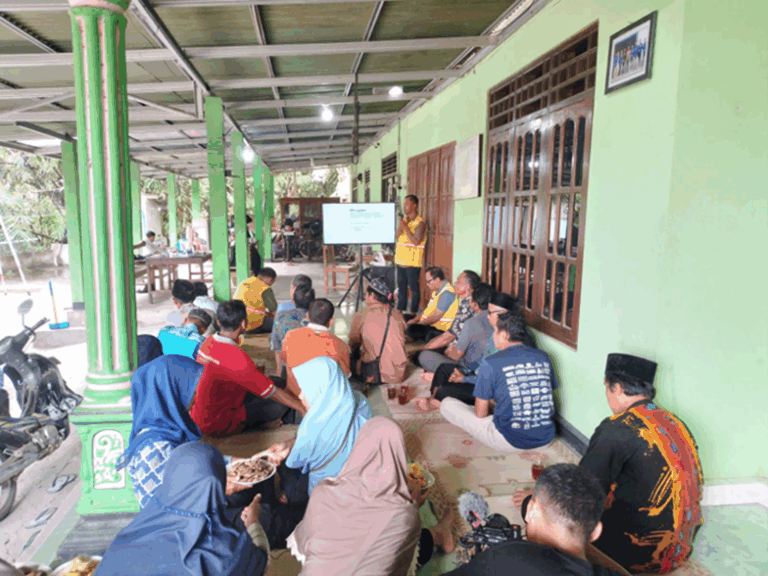
DRRC UI also collaborates with the Kulon Progo Regency Government to strengthen agricultural water security through the development and management of Embung Bendo in Bendo Hamlet, Ngentakrejo Village, Lendah District. The programme, initiated in January 2025 with the involvement of UI, Universitas Gadjah Mada (UGM), BRIN, and the local community, integrates water storage infrastructure with IoT-based monitoring and drip irrigation. The system monitors soil and water conditions, detects when the soil begins to dry, and automatically regulates water flow to deliver water directly to plant roots, reducing waste. Residents also receive training from DRRC UI on operating and maintaining the technology, enabling more efficient and independent water management. The collaboration aims to improve agricultural water resilience, particularly during dry periods, while helping farmers manage water resources according to crop needs.
Inter-University Collaboration to Develop Water Filtration Technology for Local Communities
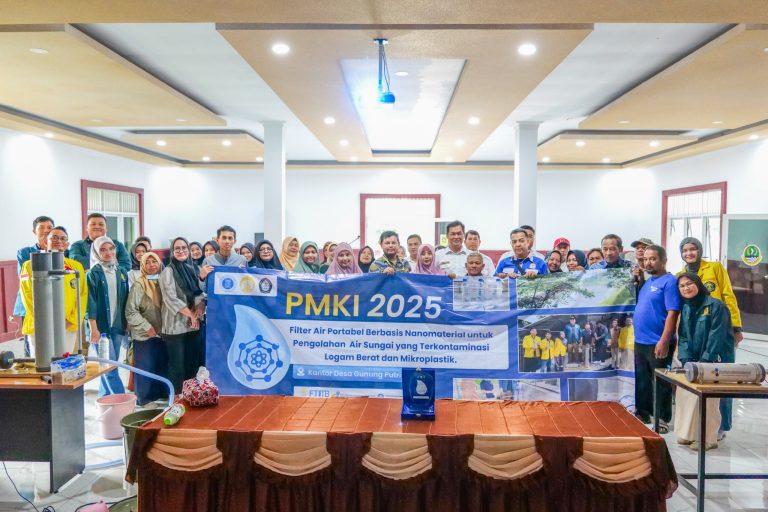
UI also collaborates with other universities to develop water treatment technologies for communities facing clean water challenges. On 20 August 2025, Universitas Indonesia (UI), Institut Teknologi Bandung (ITB), and Universitas Diponegoro (UNDIP) introduced a portable water filtration technology in Gunung Putri Village, Bogor Regency. The technology combines activated sand and activated carbon filtration with ultraviolet (UV) light and nanoparticles to reduce water contaminants, with the system reported to eliminate up to 90% of bacteria. The initiative also included community education on water treatment. Although the filtered water was not intended for drinking because the technology had not met ISO drinking water standards, it could be used for non-consumption purposes, such as washing.
Collaboration with the Menabung Air Foundation
Through FKM, UI also collaborated with the Menabung Air Foundation. Menabung Air Foundation is a non-profit organization committed to prevent water scarcity and flooding in Indonesia through nature-based solutions and the implementation of water conservation infrastructure. This collaboration took form in a community service program entitled FKM UI Peduli 21 in Lebak Parahiang Village, Banten which educated 200 local residents on water conservation and biopores; and resulted in 100 new biopore holes.
UI Promotes Conscious Water Usage on Campus
As a manifestation of the water-conscious movement on campus, UI continues to progressively replace conventional water appliances with water-efficient variations and commit to installing only water-efficient appliances in new buildings. Water-efficient appliances usage are determined as the standard for the construction and renovation of new buildings. The examples of water-efficient appliances installed at UI are as follows:
- Water taps with sensor systems in the toilets in administrative buildings and faculties. They will stop automatically to reduce dripping water when they are not in use.
- Toilet and Urinal with Eco Flush System and Dual-flush toilets in administrative buildings. They have two systems of water usage:
- Small button with water usage of 3 litres
- Big button with water usage up to 4.5 litres. They are more water efficient compared to single-flush toilets.
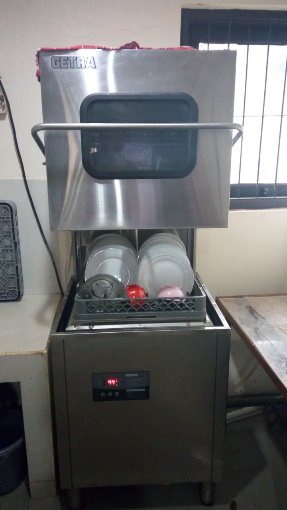
- Automatic dishwashers for canteens in faculties. Dishes washing can be conducted centrally, contributing to efficient water usage.
- Automatic plant watering system to control the daily operating hours of garden sprinklers
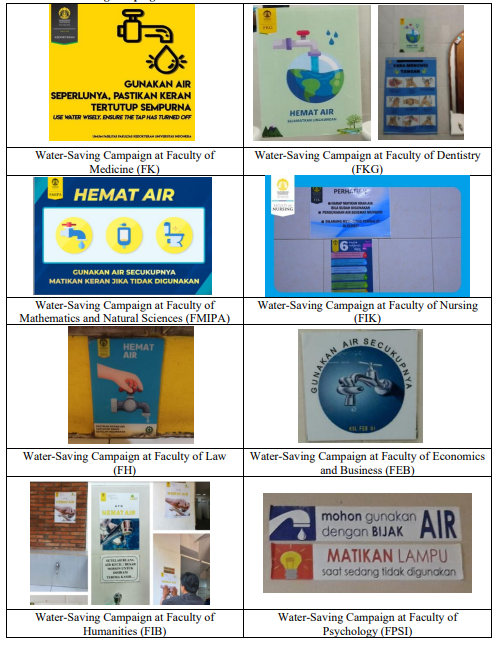
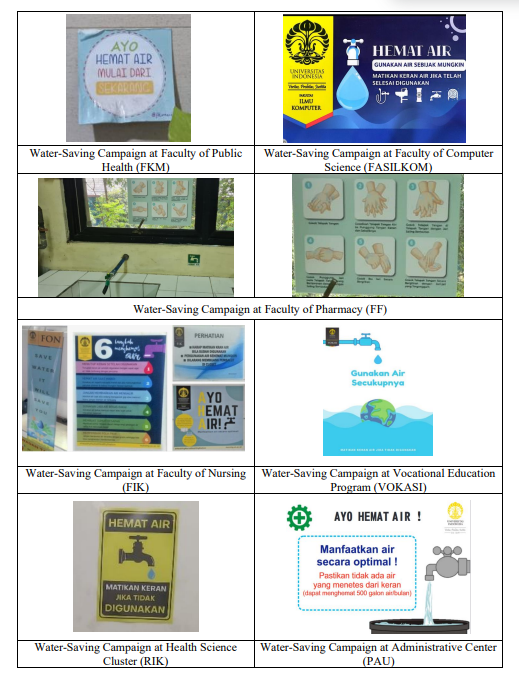
In addition to appliances, UI also actively campaigns for water-conscious practices on campus. Water conservation campaigns are put up in bathrooms and pantries to ensure everyone uses water appliances mindfully at UI. To ensure that water conservation messaging reaches the entire academic community, UI has deployed clear visual signage, stickers, and promotional displays near water-use points (restrooms, sinks, pantries, and laboratories) across faculties and administrative centers.
Eco-Efficient Infrastructure to Support Conscious Consumption
To support the community in practicing water-conscious behaviors, UI complements these campaigns with hardware retrofits:
- Sensor and Push-Type Faucets: Installed in high-traffic administrative buildings and faculty restrooms to prevent continuous dripping and accidental overuse.
- Dual-Flush & Eco-Flush Toilet Systems: Standardized 3L/4.5L dual-flush mechanisms across facilities, reducing water volume used per flush compared to single-flush systems.
- Centralized Automatic Dishwashers: Implemented in faculty canteens to streamline dishwashing with minimal water consumption.
- Automated Landscape Irrigation: Operating scheduled automated sprinklers to optimize daily garden watering without wasting freshwater.
Through this combination of visible campaign messaging across every faculty and modern water-saving fixtures, Universitas Indonesia ensures that conscious water usage is actively promoted and embedded in campus daily operations.

UI Promotes Conscious Water Usage in the Wider Community
UI promotes conscious water usage in the wider community through educational programmes, public awareness campaigns, and community engagement initiatives that encourage responsible water use and environmental stewardship. In addition to the community outreach and education programs previously mentioned (namely FKM UI Peduli 21, SPPB’s collaboration with the Muaragembong District Government, and UI’s collaboration with PT KAI), the following are several initiatives UI implements to promote conscious water usage in the wider community:
Generasi Cerdas Lingkungan (GENCERLING)
Through the Lemtek UI, UI conducted the Generasi Cerdas Lingkungan (GENCERLING) program. This program supports efforts to raise awareness of water conservation and environmental sustainability among younger generations. In 2025, the programme focused on teacher training, the development of learning modules, and student exhibitions addressing water security and climate change. Using a problem-based learning approach, GENCERLING encourages elementary school students to understand water-related challenges and share their observations and environmental messages with their communities.

Water Conservation Awareness Campaign by FT UI
FT UI also promotes water conservation awareness through social media campaigns. These communication efforts help disseminate messages about the importance of responsible water use and environmental protection beyond the university campus.

Community Water and Sanitation Education by FKM UI
UI’s Faculty of Public Health (FKM) raises public awareness of water-related environmental health issues through social media and a talk show held in conjunction with World Water Day 2025. These activities support public education on the impacts of water pollution and support the Community-Based Total Sanitation (STBM) program.

UI's SDG 6 Report