Our actions and goals
Click the SDG Goals to read the initiatives




SDG 16: Peace, Justice, and Strong Institutions
Promote peaceful and inclusive societies for sustainable development, provide access to justice for all and build effective, accountable and inclusive institutions at all levels
Institutional Governance Framework and Local Stakeholder Engagement Mechanisms
Institutional Governance Framework and Leadership Structure
The University of Indonesia (UI) maintains a transparent, participatory, and democratic institutional governance framework fulfilling the highest standards of higher education accountability. In accordance with Law No. 12 of 2012 on Higher Education and Government Regulation No. 75 of 2021 concerning the Statute of the University of Indonesia, the Board of Trustees (Majelis Wali Amanat / MWA UI) serves as the university’s supreme governing body. The MWA UI holds ultimate normative authority over long-term strategic planning, financial oversight, institutional policy formulation, non-academic governance, and the appointment and annual evaluation of the Rector.
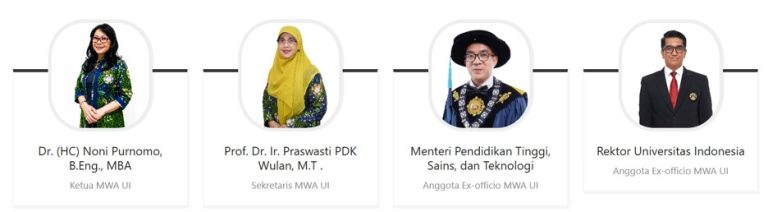
Board leadership is headed by Dr. (HC) Noni Purnomo, B.Eng., MBA. as Chair of MWA UI, representing independent community leaders from outside the university to guarantee objective oversight and strategic synergy with societal and industry needs. Operational administration and academic alignment are supported by Prof. Dr. Ir. Praswasti PDK Wulan, M.T. as Secretary of MWA UI. Institutional alignment with national policies and executive campus management is further reinforced by ex-officio members, comprising the Minister of Higher Education, Science, and Technology of the Republic of Indonesia and the Rector of the University of Indonesia. The MWA is further supported by two independent specialized committees: the Audit Committee (Komite Audit) for financial and accounting oversight, and the Risk Committee (Komite Risiko) for evaluating institutional development and partnership risk profiles.
Multi-Constituency Democratic Representation & Internal Voting Structures
To ensure equitable stakeholder participation in strategic decision-making, the 17-member composition of MWA UI incorporates democratically elected representatives from all internal university constituencies alongside prominent external community leaders (appointed for 5-year terms, with student representatives serving a 1-year term). As detailed on the official governance portal (mwa.ui.ac.id/anggota-mwa), the governing body explicitly includes:
- Faculty Representation (Academic Staff/Wakil Dosen):
Faculty members are represented on MWA UI through members elected directly by and from the Academic Senate (Senat Akademik UI). These elected academic representatives bring frontline pedagogical, research, and scholarly insights into high-level institutional governance, ensuring that academic freedom and quality standards remain central to university policies.
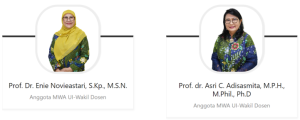
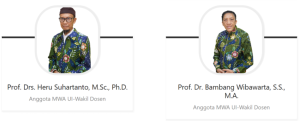
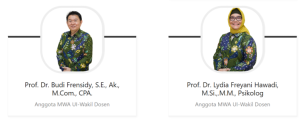
Member of the UI Board of Trustees (MWA UI) – Faculty Representative
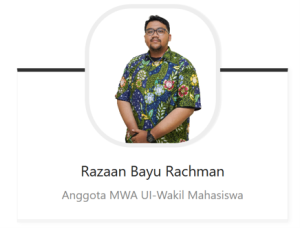
- Student Representation (Undergraduate and PostGraduate Cohorts/Wakil Mahasiswa):
Students across both undergraduate and postgraduate levels are granted formal voting and advisory representation on MWA UI through an elected Student Representative (Unsur Mahasiswa). This representative actively voices the concerns, rights, and welfare of the student body, participating directly in discussions on tuition policy, campus facilities, academic support services, and student affairs.
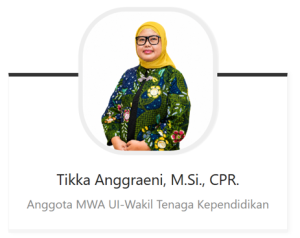
- Staff Representation (Non-Faculty Employees/Wakil Tenaga Kependidikan):
Non-academic professional and administrative staff are represented on MWA UI through an elected Staff Representative (Unsur Tendik / Tenaga Kependidikan). Elected by non-faculty employees across all university directorates, faculties, and administrative units, this representative ensures that administrative efficiency, staff welfare, labor rights, and operational perspectives are integrated into executive governance decisions.
- Community Representation (External Stakeholders / Wakil Masyarakat):
To ensure public accountability and strong alignment with social, religious, financial, and industrial sectors, MWA UI includes distinguished independent community representatives below:
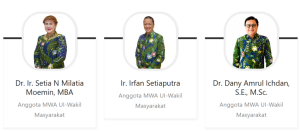
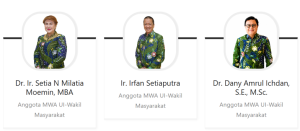
Community Representation MWA UI
By embedding democratically elected representatives from the faculty, student body, and administrative staff alongside independent community leaders and government officials, the University of Indonesia guarantees a robust checks-and-balances system. This inclusive structure empowers all internal and external university stakeholders to participate directly in approving institutional budgets, setting strategic development goals, and safeguarding the university’s public mission.
Institutional Recognition and the Strategic Role of the Student Executive Board (BEM) of the University of Indonesia in Governance and Community Service
- Official Institutional Recognition and Democratic Governance InputThe University of Indonesia (UI) officially recognizes the Student Executive Board (Badan Eksekutif Mahasiswa / BEM UI) at the university level, alongside its respective faculty-level student executive bodies, as independent, democratically elected unions representing the entire student body. Rather than operating purely as extracurricular entities, these student unions are formally embedded into the university’s governance and administrative feedback channels, serving as key consultative partners to executive university leadership:
- Direct Executive Dialogue and Policy Advocacy: Faculty-level student unions regularly conduct structured policy forums with university management.
- DIORAMA: BEM Faculty of Administrative Science UI organizes DIORAMA (Dialog Bersama Manajer), held on November 14th, 2025, at Auditorium EDISI 2020, M Building, 4th Floor. This event is an institutional platform that connects student representatives directly with faculty managers to submit student aspirations, evaluate academic infrastructure, and optimize administrative services.
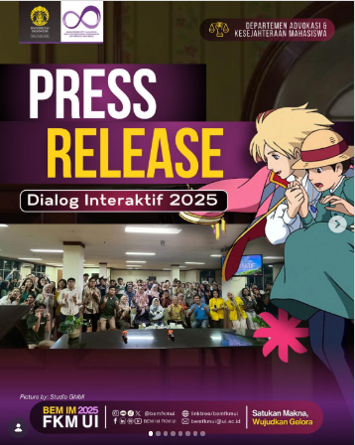
- Dialog Interaktif (Log-In) 2025: On May 28, 2025, BEM IM FKM UI convened an offline policy dialogue themed “DREAM: Dialogue for Reflection Through Aspiration and Motivation” in the Ruang Promosi Doktor FKM UI. This institutional forum brought together the student body and the complete executive leadership of the faculty—including the Dean, Vice Deans, Faculty Secretary, Student Affairs Managers, Program Study Heads, and Administrative Coordinators—to discuss key student aspirations. The dialogue resulted in direct administrative commitments and policy clarifications regarding campus facility enhancements, academic regulations, practical learning deployments, and tuition fee governance.
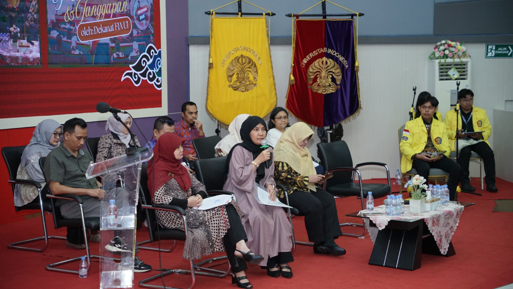
- Silaturahmi Dekanat 2025: Building upon mid-year advocacy, BEM IM FKM UI organized an official consultative forum on December 18, 2025. Representatives from the Advocacy and Student Welfare Department (Adkesma) presented comprehensive, data-driven student survey results directly to executive faculty leadership, including the Dean (Prof. Indri Hapsari Susilowati), Vice Deans, Managers, and Coordinators for the 2025–2029 leadership term. The survey systematically compiled objective student feedback and policy recommendations covering student welfare, academic services, and learning infrastructure. The Deanery explicitly commended the student-led initiative, utilizing the findings as a key benchmark for continuous institutional improvement.
- Evidence-Based Institutional Research: Student unions actively conduct rigorous campus-wide research to inform administrative decision-making. Initiatives such as BEM FKM UI’s World Mental Health Day Survey and the Psychology Student Research Team’s (TRACK 2025) study titled “Has UI Become a Mentally Healthy Campus?”, conducted by BEM Faculty of Psychology UI, evaluate student psychological well-being, social stigma, and counseling accessibility. The findings are formally submitted to university leaders to guide the development of a healthier, more supportive campus environment.
- Direct Executive Dialogue and Policy Advocacy: Faculty-level student unions regularly conduct structured policy forums with university management.


- Comprehensive Student Support Services and Financial Aid
Beyond policy advocacy, independent student unions at the University of Indonesia design and execute wide-ranging support programs that directly bolster student welfare, financial stability, and academic development:
- Targeted Financial Assistance and Mentorship (Bakti Asa UI 2025): BEM UI—specifically through its Department of Advocacy and Student Welfare (Dept. Adkesma BEM UI 2025)—initiates and manages the Bakti Asa UI 2025 Scholarship. Designed as a flagship, student-led support system for active UI undergraduates, the program provides a financial grant to ease the educational financial burden. Beyond monetary aid, the program incorporates a structured capacity-building series titled Scholar’s Lab, delivering soft-skills training, personal development workshops, and two dedicated mentoring sessions (held on November 8 and 15, 2025). The selection process spans document screening, interviews, and mentoring evaluation (October–November 2025), fostering a peer-support network connecting awardees with experienced mentors.


Bakti Asa UI 2025 Scholarship
- Peer-Led Mental Health Advocacy and Rapid Intervention: Recognizing the critical need for accessible mental health support and to overcome long waiting lists at formal health units, the student ecosystem operates PCHE (Peer Counselor and Health Educator) UI. Managed as a peer-counseling service by trained fellow students under the guidance of professional psychologists, PCHE UI provides a safe, confidential, and immediate space for students to share their concerns without long waiting periods. If necessary, PCHE UI acts as a direct bridge to professional psychological services. This initiative, supported by BEM UI, actively breaks psychological stigmas and ensures immediate, friendly support for student well-being.


PCHE (Peer Counselor and Health Educator) UI
- Community Engagement, Environmental Stewardship, and Social Impact
Demonstrating strong civic responsibility, BEM UI and its faculty branches lead extensive humanitarian, educational, and environmental programs that extend the university’s social impact locally and nationally:
- Educational Outreach in Urban and Remote Areas:
- Urban and Remote Education (BEM UI): Student unions spearhead flagship community service projects designed to bridge educational disparities. Programs include Rumah Belajar (Rumbel), which provides free, routine weekly learning support (every Saturday) for underprivileged children in urban Depok (such as Rumbel 18 and Rumbel 19 under BEM UI 2024); Langkah Kecil untuk Negeri (LKUN), delivering targeted interactive educational interventions at SDN Kemiri Muka 1 Depok; and Gerakan UI Mengajar (GUIM), an intensive 30-day educational deployment sending student volunteers to teach and empower children in remote, underserved rural regions. Specifically, GUIM 14 was deployed from January 4 to February 1, 2025, across six locations in Blora Regency, Central Java (including SDN 2 Bleboh, Jiken District), while GUIM 15 operates throughout late 2025 leading into January 2026.
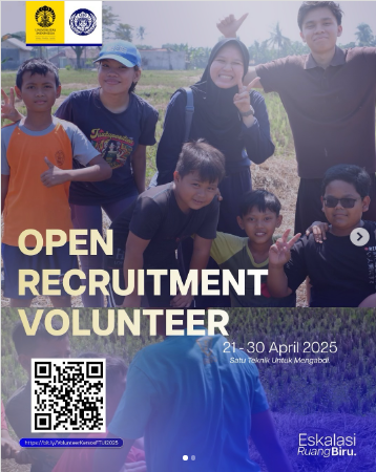
- Engineering Social Service / Kerja Sosial (Kersos) FT UI 2025: Organized by BEM FT UI, this initiative recruited student volunteers (recruitment open April 21–30, 2025) to mobilize technical skills for direct community assistance, grassroots social action, and infrastructure/welfare development in target communities.
- Environmental Stewardship, Coastal Conservation & Renewable Energy: Student-led environmental organizations actively drive tangible ecological restoration and sustainability campaigns:
- UI Youth Environmental Action (UIYEA) 2025: A comprehensive 10-day sustainability campaign featuring circular economy workshops, organic waste management training, disaster preparedness education for primary school children, solar panel installation, coral reef rehabilitation, tree planting, and beach clean-ups in Banyuasih.
- Coastal Restoration via TekTukBum (BEM FT UI): On November 15, 2025, BEM FT UI mobilized over 100 student volunteers under the TekTukBum environmental program to plant more than 400 seagrasses (lamun) at Pulau Pramuka, Kepulauan Seribu, restoring marine ecosystems and protecting coastal shores.
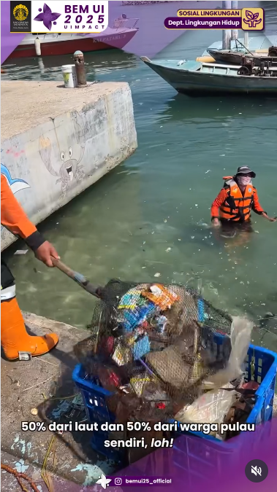
- Regional Waste Governance (BEM UI): On July 8, 2025, representatives from BEM UI’s Department of Environment attended an official invitation by the Kepulauan Seribu Environment Office to participate in the Social Collaboration Forum (KSBB) Waste Cluster on Pulau Lancang. The team partnered with local municipal governments, companies, and coastal residents to address marine debris (averaging 19 tons of waste monthly), establish waste-sorting and composting systems, cultivate maggot units, and promote sustainable eco-literacy.
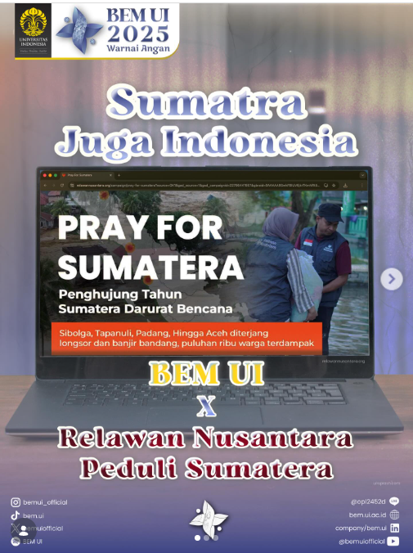
- Nationwide Disaster Relief and Emergency Response: Through emergency fundraising and volunteer coordination—such as the Sumatra Juga Indonesia campaign launched in late 2025 in partnership with Relawan Nusantara—BEM UI mobilizes campus-wide support to deliver vital emergency logistics (emergency food packs, clean water, healthcare items, blankets, and women/infant supplies) to communities affected by severe floods and landslides across Aceh, North Sumatra, and West Sumatra.
- Educational Outreach in Urban and Remote Areas:



Analysis of Policies and Procedures for Identifying External Stakeholders under Universitas Indonesia Rector Regulation Number 3 of 2023

UI institutionally has complete, valid, and binding written policies and procedures to identify and manage interactions with local stakeholders outside the university environment. This policy is enshrined in the Regulation of the Rector of Universitas Indonesia Number 3 of 2023 on Cooperation Management, which was officially enacted on January 24, 2023.
Stakeholder Identification
The written policy stipulates that every collaboration must begin with a partner identification and risk assessment phase. This Rector’s Regulation specifically maps out local stakeholders (domestic partners) outside the university that can be identified and engaged with. This identification process includes determining the qualifications of local stakeholders as well as verifying their compliance with general and specific requirements.
- Partner Integrity and Eligibility Criteria: In identifying stakeholders, Article 6 paragraph (2) establishes integrity requirements.
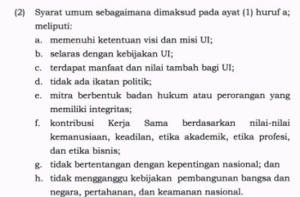
Quote from Article 6 paragraph (2):
“The general requirements as referred to include: a. meeting the provisions of UI’s vision and mission; b. aligning with UI’s policies; c. providing benefits and added value for UI; d. having no political affiliations; e. partners being legal entities or individuals of integrity; f. collaboration contributions being based on human values, justice, academic ethics, professional ethics, and business ethics; g. not contradicting national interests; and h. not disrupting national development, defense, and national security policies.”
- Local Stakeholder Scope (Domestic Partner Subjects): UI explicitly identifies six categories of local stakeholder subjects outside the university that can be engaged and collaborated with, as regulated under Article 6 paragraph (3) letters a and b.
Quote from Article 6 paragraph (3) letter a:
“Specific requirements that must be met with domestic partners include: a. domestic partner subjects may consist of: 1. individuals; 2. legal entity business organizations; 3. non-legal entity business organizations; 4. ministries/agencies/government institutions; 5. universities/higher education institutions/similar institutions; and/or 6. community organizations/associations/societies.”
Quote from Article 6 paragraph (3) letter b:
“b. partners are not engaged in: 1. the tobacco/cigarette industry; 2. the alcoholic beverage industry; 3. illicit narcotics trafficking and/or addictive substance crimes; 4. money laundering crimes; 5. tax evasion; and 6. corruption.”
- Standard Stages and Procedures for Stakeholder Engagement This regulation outlines a structured procedure and workflow that all working units must follow when engaging with external stakeholders, divided into four main stages pursuant to Article 8:
Quote from Article 8:
“The proposer must conduct Collaboration by following the stages, comprising: a. planning; b. verification; c. drafting the Collaboration document; and d. Signing.”
The 4 workflows above are explained as follows:
- Planning Stage & Initial Communication: Pursuant to Article 9 paragraph (1), the proposer must initiate engagement by communicating directly with domestic partners to collect data and information, which is then followed up by submitting an official internal memorandum via UI’s electronic official document application.
Quote from Article 9 paragraph (1):
“The proposer must undertake Collaboration planning as referred to in Article 8 letter a, by: a. communicating with domestic partners and/or foreign partners involved in the Collaboration to collect information and data; and b. following up on the agreed planning by submitting a Collaboration request.”
- Verification & Risk Management Analysis Stage: Pursuant to Article 5 and Article 7, every potential collaboration is classified into three risk levels: Low Risk, Medium Risk, and High Risk. For medium-risk and high-risk collaborations, cross-unit verification is conducted by involving the finance unit (tax and virtual account analysis), the legal unit, and relevant technical units to ensure prudence, transparency, and accountability.
Quote from Article 5:
“In the event that a Collaboration is to be conducted, the Proposer and/or the working unit responsible for Collaboration affairs must identify the Collaboration, which includes: a. Collaboration requirements; and b. Collaboration assessment processing.”
Quote from Article 7 paragraph (1):
“Types of Collaboration processing are distinguished based on the assessment of risk levels, consisting of: a. Low Risk; b. Medium Risk; and c. High Risk.”
- Drafting & Legal Document Preparation Stage: Pursuant to Article 17 paragraphs (1) and (3), every agreement document with domestic partners must be drafted in Indonesian as the primary reference to ensure legal certainty. The document drafting may take the form of a Memorandum of Understanding (non-legally binding) or a Cooperation Agreement (creating legally binding obligations).
Quote from Article 17 paragraph (1):
“Every Collaboration with domestic partners must be drafted in Indonesian.”
Quote from Article 17 paragraph (3):
“In the event of a dispute and/or differing interpretations, the parties must use Indonesian as the reference.”
- Signing, Documentation, & Evaluation Stage: According to Article 19 paragraph (1), the signing of collaboration documents can be conducted directly or using official electronic signatures. The proposer is required to return the signed document to be archived in UI’s official database. Furthermore, the implementation of engagement is monitored through periodic monitoring and evaluation by the Vice Rector, Deans/Directors, and the working unit responsible for collaboration affairs.
Quote from Article 19 paragraph (1):
“Monitoring and evaluation of Collaboration are carried out by: a. the Vice Rector responsible for collaboration affairs; b. deans/school directors/director of the vocational education program; and/or c. working units responsible for collaboration affairs.”
This Regulation of the Rector of Universitas Indonesia Number 3 of 2023 was officially enacted in Jakarta on January 24, 2023, by the Rector of Universitas Indonesia, Prof. Ari Kuncoro, S.E., M.A., Ph.D. This policy represents a comprehensive review and update of the previous regulation, namely Rector’s Regulation Number 020 of 2016 concerning Guidelines and Technical Instructions for Cooperation Management at Universitas Indonesia. Pursuant to Considering letter b and the provisions of Article 24, this update was undertaken because the previous regulation was considered no longer aligned with legal developments and had not yet accommodated risk management principles in forming collaborations. With the entry into force of this 2023 policy, Rector’s Regulation Number 020 of 2016 is officially repealed and declared null and void to meet the needs of a more adaptive and integrated collaboration governance within Universitas Indonesia.
Publication of UI’s Principles and Commitments on Anti-Corruption, Anti-Bribery, and Integrity Governance
UI has officially and publicly released a set of governance policies applicable to all members of the university community (faculty, students, administrative/support staff, and leadership). The institution’s commitment to preventing corruption and bribery, managing gratuities, and ensuring legal compliance is comprehensively addressed through Rector’s Regulations, Rector’s Decrees, and Integrity Pacts for university leadership.
Universitas Indonesia establishes anti-corruption as an integral part of its core values of honesty and institutional responsibility:
- Strict Prohibition of Corruption: Under UI Rector’s Regulation No. 4 of 2024 concerning the UI Code of Ethics and Code of Conduct, the core value of honesty requires every member of the UI community to speak and act with integrity; it explicitly prohibits acts of corruption, fraud, and dishonesty.
Quote from Article 14 of UI Rector Regulation Number 4 of 2024:
“In order to uphold the fundamental value of honesty, members of the UI community are prohibited from: (a) engaging in plagiarism, which is fundamentally contrary to the values of honesty; (b) lying, deceiving, engaging in corruption, or cheating; and (c) any other actions that provide support or facilities for conduct contrary to the values of honesty, such as intentionally assisting—or attempting to assist—others in carrying out dishonest acts.”
- Preventing Corruption, Collusion, and Nepotism (KKN) through the Management of Conflicts of Interest: Through UI Rector’s Regulation No. 4 of 2024 and UI Rector Regulation No. 7 of 2022, the University of Indonesia (UI) establishes procedures for managing conflicts of interest to prevent the occurrence of corruption, collusion, and nepotism (KKN) in decision-making, the procurement of goods and services, and the provision of public services.

Quote from Article 8 of UI Rector Regulation Number 4 of 2024:
“The core value of responsibility entails acting responsibly in the execution of one’s official duties and functional tasks, while avoiding conflicts of interest that could prove detrimental to the interests of the University of Indonesia (UI) and/or its community members. To uphold this core value, every member of the UI community must avoid conflicts of interest—which includes refusing bribes or similar inducements—that could influence decision-making in the performance of their duties and functions, and thereby cause harm to UI and/or its community members.”
Add Your Heading Text Here
Lorem ipsum dolor sit amet, consectetur adipiscing elit. Ut elit tellus, luctus nec ullamcorper mattis, pulvinar dapibus leo.
UI Provides Evidence-Based Expert Advice at Local, Regional, and National Levels
As a leading higher education institution in Indonesia, University of Indonesia (UI) consistently fulfills its role as an independent think tank and a strategic partner to the government. Through multidisciplinary research, technical analysis, the development of policy briefs, and the active participation of its academic community in expert committees and forums, UI provides specialized, evidence-based policy advisory to support public policy formulation and sustainable development at the local, regional, and national levels.
Local Level: Strengthening Governance, Social Data, and Development in Depok City
At the regency/city level, UI acts as a primary partner to the Depok City Government in addressing urban issues, governance, and poverty alleviation:
- Addressing Urban Issues and Socio-Economic Solutions: On March 9, 2025, the Center for Islamic Economics and Business (PEBS) at the Faculty of Economics and Business, Universitas Indonesia (FEB UI), in collaboration with the Institute for Human Resource Study and Development of the Nahdlatul Ulama Depok Branch (Lakpesdam PCNU Depok), held a discussion titled “Assessing Strategies to Address the Various Challenges Facing the City of Depok.” The event took place in the Prof. Mr. Djokosoetono Room at FEB-UI, Depok. This expert discussion focused on recommending solutions for the economic dynamics and urban social issues present in Depok.
- Urban Development and Community Empowerment Partnership: On June 20, 2025, the Depok City Government and the University of Indonesia (UI) signed a Memorandum of Understanding (MoU) to serve as the legal framework for providing academic expertise in support of public infrastructure development and local community empowerment.
- Development of Local Government Governance: On July 29, 2025, the Faculty of Administrative Sciences (FIA) at the University of Indonesia (UI) held a strategic meeting with the Depok City Government to design programs aimed at enhancing the capacity of civil servants (ASN) and modernizing local bureaucratic governance.
- Integrating Social and Housing Data for Poverty Alleviation: On August 24, 2025, the Demographic Institute of the Faculty of Economics and Business, Universitas Indonesia (FEB UI), explored a strategic partnership with the Ministry of Housing and Settlement Areas and the Depok City Government to integrate social and housing data, aiming to facilitate data-driven policy interventions for alleviating urban poverty.


Regional Level: Infrastructure Planning, Urban Transformation, and Sanitation in the Special Capital Region of Jakarta (DKI Jakarta)
At the provincial level, UI plays an active role in providing technical studies and spatial planning input to the Jakarta Provincial Government as it transforms Jakarta into a global city:
- Analysis of Urban Sanitation Tariff Policy: On July 16, 2025, Paljaya partnered with the Institute of Technology at the University of Indonesia (Lemtek UI) to develop a tariff study based on measurable and accountable technical and financial modeling. The findings of this study are presented in a policy recommendation report, which serves as a reference for Paljaya’s management and the Jakarta Provincial Government in establishing service tariffs. With the support of a multidisciplinary team of experts in environmental engineering, economics, and finance, Lemtek UI provides solutions that are not only focused on the sustainability of services but also deliver added value to the community and the city.
- Technical Study on Rainwater Management in DKI Jakarta: On October 20, 2025, the Technology Institute (Lemtek) of the Faculty of Engineering, University of Indonesia (FTUI), was appointed by the Jakarta Provincial Water Resources Agency to conduct an engineering study and develop a Detailed Engineering Design (DED) for rainwater management facilities within the DKI Jakarta region. This study aims to establish the technical foundation for planning stormwater infrastructure—including retention, detention, and infiltration systems—to reduce the risk of inundation and maintain groundwater reserves in urban areas.
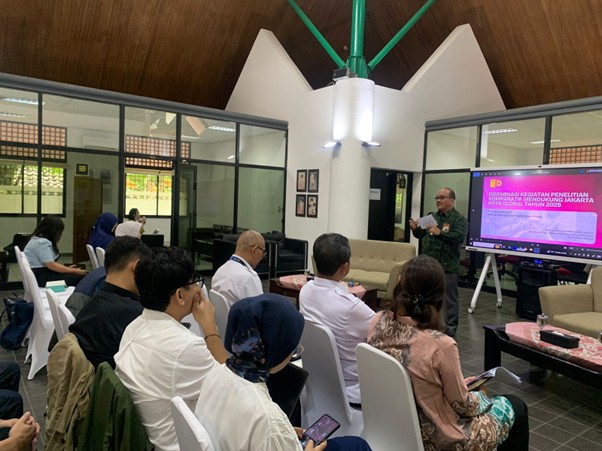
- Formulating Strategic Directions for Jakarta as a Global City: On November 12, 2025, the Graduate School of Sustainable Development (SPPB) at the University of Indonesia (UI), in collaboration with the Regional Development Planning Agency (Bappeda) of the Jakarta Special Capital Region, held a dissemination event for a comparative study titled “Comparative Research in Support of a Global City 2025” at the Japanese Studies Hall. Prof. Gunawan Tjahjono, Ph.D., a senior urban studies expert at the University of Indonesia, provided constructive feedback to participants from Bappeda, who presented their research findings—work that will subsequently be formulated into a policy brief.


National Level: Policy Inputs for the Health, Macroeconomic, Legal, and Environmental Sectors
At the national level, experts from UI actively provide policy advocacy to high-level state institutions (the House of Representatives and the Regional Representative Council of the Republic of Indonesia), government ministries, Bank Indonesia, and the industrial sector:
Evidence-Based Health Policy Advocacy:
- On April 24, 2025, the Faculty of Public Health at the University of Indonesia (FKM UI) held a strategic hearing with Commission IX of the House of Representatives (DPR RI) and the Regional Representative Council (DPD RI) to advocate for the development of evidence-based national health legislation and policies. During the hearing, which took place at the DPR/DPD RI complex in Jakarta, the faculty presented findings from field studies and a policy brief that outlined the current state, challenges, and strategic recommendations regarding public health in Indonesia.
- On July 31, 2025, the Faculty of Public Health at the University of Indonesia (FKM UI) developed an intersectoral policy brief concerning health risk analysis resulting from industrial downstreaming—specifically regarding the threat of Interstitial Lung Disease (ILD) and pulmonary fibrosis. This initiative involved various stakeholders across different professions and institutions, including the Ministry of Energy and Mineral Resources (ESDM); the Task Force for Industrial Downstreaming and Respiratory Health; Persahabatan General Hospital; Gatot Soebroto Army Central Hospital; Sulianti Saroso Infectious Diseases Hospital; the University of Indonesia Hospital (RSUI); the Faculty of Medicine at the University of Indonesia (FKUI); the Indonesian Society of Respirology (PDPI); the Indonesian Society of Occupational Health Physicians (IDKI); and the Indonesian Society of Occupational Medicine Specialists (PERDOKI).
- On October 28, 2025, the Faculty of Nursing (FIK) at the University of Indonesia (UI) presented its evaluation and feedback regarding the implementation of the National Health Insurance (JKN) program during a working visit to Commission IX of the House of Representatives of the Republic of Indonesia (DPR RI). During the discussion, UI highlighted several key issues, including disparities in service quality across different regions, challenges in managing the quality of healthcare services, and the vital role of nursing professionals in ensuring the continuity of JKN-covered care. This dialogue fostered reflection on the importance of multi-stakeholder collaboration—involving the government, academic institutions, healthcare facilities, and professional organizations—to strengthen the JKN ecosystem as a whole.
Expert Recommendations for the Macroeconomic Sector and the Achievement of the SDGs:
- On October 21, 2025, the SDGs Hub UI published an External Review Report in collaboration with PT Bank Tabungan Negara (Persero) Tbk (BTN), serving as an external guide for the implementation of Environmental, Social, and Governance (ESG) practices and the achievement of national SDG targets.
- On November 18, 2025, the Institute for Economic and Social Research (LPEM) at the Faculty of Economics and Business, University of Indonesia (FEB UI), published an analysis of monetary and macroeconomic conditions, serving as an independent input ahead of the Bank Indonesia Board of Governors Meeting (RDG) in November 2025.
Expertise in Environmental Law and Energy Transition/Critical Minerals Policy:
- On September 26–27, 2025, faculty members and experts from the Faculty of Law, Universitas Indonesia (FH UI), served as key speakers at the 2025 Experts’ Forum: Optimizing the Role of Experts in Supporting Environmental Law Enforcement, organized by the Ministry of Environment/Environmental Management Agency of the Republic of Indonesia. The event aimed to strengthen networks of expertise, evaluate the effectiveness of environmental regulations, and gather concrete recommendations from stakeholders to support the enforcement of environmental law in Indonesia.
UI's SDG 16 Report