


Sustainability at Universitas Indonesia

Our actions and goals

Click the SDG Goals to read the initiatives

SDG 5: Gender Equality

Achieve gender equality and empower all women and girls

UI Systematically Tracks Female Application and Acceptance Rates to Ensure Fair Admissions

Universitas Indonesia (UI) systematically measures and tracks women’s application, acceptance, and entry rates through an integrated, web-based admissions information system (penerimaan.ui.ac.id). Managed by UI’s Student Admissions Office (KPMB), this systematic practice reflects UI’s core commitment to institutional fairness, meritocracy, and gender equality under Sustainable Development Goal 5 (Gender Equality).

Systematic Data Tracking via Centralized Admissions System

Through penerimaan.ui.ac.id, UI maintains a centralized database management system that records applicant records and selection outcomes across all admission channels (SNBP, SNBT, SIMAK UI, and international programs). The platform automatically generates gender-disaggregated metrics, enabling UI to systematically monitor trends in women’s application rates, acceptance rates, and final entry rates over time. This continuous data audit ensures that UI can proactively identify potential gender disparities and design targeted interventions if needed.

Admission and Entry Outcomes

Out of 10,900 accepted students starting their degrees at UI, the merit-based selection outcomes highlight strong representation and high competitiveness among female scholars:

Percentage of Students Starting a Degree by Gender

These empirical figures confirm that female students achieve high entry rates across UI’s academic programs, proving that UI’s transparent, merit-based admission framework fosters an equitable entry environment for female scholars.

UI Codifies Equitable Access Policies to Guarantee Female Student Participation Across All Academic Programs

Additionally, as a public university, UI is bound and must abide by governmental regulations for all Indonesian public universities. Regarding the process applications and acceptance, UI implements the principles outlined in Clause 2 of the Regulation of the Minister of Higher Education, Science, and Technology No. 3 of 2026 on the Admission of New Students for Diploma Programs and Undergraduate Programs at Public Universities. This regulation is an update on the Regulation of the Minister of Education, Culture, Research, and Technology No. 62 of 2023 on Amendments to Regulation of the Minister of Education, Culture, Research, and Technology No. 48 of 2022 on Admission of New Students for Diploma Programs and Undergraduate Programs at Public Universities, which was the basis of UI’s very own regulations on admission, namely:

  1. UI Rector’s Regulation No. 18 of 2024 on the New Student Admissions for Universitas Indonesia’s Postgraduate Programs; and

  2. UI Rector’s Regulation No. 2 of 2023 on the New Student Admissions for Universitas Indonesia’s Undergraduate Programs.

These governance instruments establish the institutional mandate for equal access and provide the regulatory basis for collecting and monitoring admissions data across programs.

UI Fosters Women’s Empowerment Through Targeted Scholarships, Mentorship, and Student Communities

As outlined in the regulations and policies that shape our university, UI embeds fairness in every step of our admissions process. The Statute of Universitas Indonesia (Government Regulation No. 75 of 2021), as well as the the Regulation of the Minister of Higher Education, Science, and Technology No. 3 of 2026 on the Admission of New Students for Diploma Programs and Undergraduate Programs at Public Universities which UI has adopted into our own Rector’s Regulations are governance instruments to ensure women get equal opportunities at UI. 

Implementation of these policies have led to balanced gender representation in year‑to‑year intake data and academic outcomes, with female students demonstrating academic parity with male peers in graduation rates and performance indicators. While the evidence shows no significant systemic disadvantage for women in either access or academic progression, UI acknowledges that adequate support for women in academics is still needed regardless of statistics because this balanced representation has yet to become the reality worldwide. Therefore, UI provides support for female students through access to specialized scholarships and other supporting programs and communities. These scholarships and community activities often also provide mentoring to female students for personal and professional development.

Tailored Scholarship Schemes for Female Scholars

To support female students in achieving academic and professional excellence, UI actively promotes and facilitates access to targeted women-exclusive scholarship packages. In 2025, UI encouraged and supported student applications for several prominent funding schemes:

Amartha STEAM Fellowship

Empowering female students pursuing science, technology, engineering, arts, and mathematics
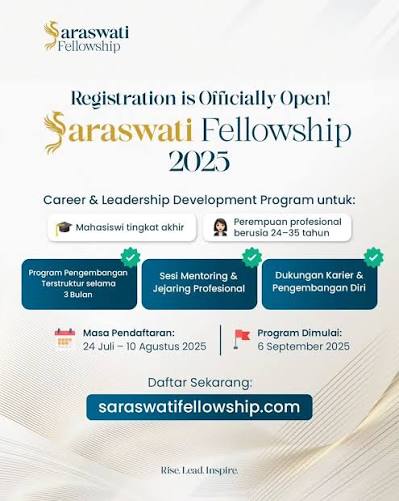
Saraswati Fellowship

Providing financial aid and leadership development for high-achieving female scholars.
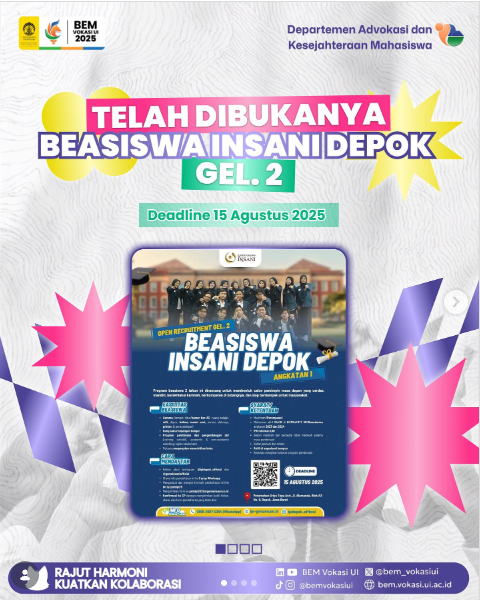
Insani Depok Scholarship

Supporting underprivileged female students from the local Depok community.

Glow & Lovely Bintang Scholarship

Assisting graduating high school female students to pursue higher education at UI.

Women’s International Club (WIC) Jakarta Scholarship

Delivering academic financial grants for female undergraduate candidates.

These scholarships have frameworks that incorporate tailored mentorship modules focusing on career planning, personal branding, and executive leadership.

Mentoring, Counseling, and Support Programs for Women

UI allocates academic supervisors to all students, who offer professional, personal, and academic guidance. UI has also allocated faculty to act as counselors in all 16 faculties and schools at UI. These guidance counselors regularly receive training and development to ensure they remain qualified to guide and counsel students. In addition to the efforts UI puts in, our students have also taken the initiative to provide support for their juniors, especially incoming freshmen. Student orientation programs assign mentoring groups to ensure students are able to settle into university life well. The mentors undergo training from certified experts to ensure they are qualified to assist their juniors in their transition into campus life.

Freshmen orientation events are designed to help incoming students to not only adapt to both the academic and social aspects of campus life, but also envision their future career path in their respective fields. Other than mentoring, these events include talkshows and discussions from notable figures and successful alumni in both a professional career and academia.

Creative mentoring program at FMIPA UI's freshmen orientation
Channeling interests on campus section of FPsi UI's freshmen orientation
Academic talkshow during faculty orientation
Career talkshow during faculty orientation

Several faculties go the extra mile to provide support well after orientation ends. Student Associations in several departments run buddy programs that assign a senior student to freshmen to act as their mentor throughout campus life. Students Associations at faculties often provide peer counseling and mentoring outside of these buddy programs. Over at the Faculty of Administrative Sciences (FIA), the Student Advocacy and Welfare (Adkesma) division of FIA’s Student Association worked in collaboration with the FIA UI’s Student Affairs Unit to launch a counseling scheme entitled ‘Psychological Counseling with MUDITA.’

Through this combination of initiatives providing scholarships, mentoring, and support for women, UI strives to ensure a substantial amount, if not all, female students have access to the right support network in order to have a fulfilled campus life and future career.

Buddy program at FMIPA UI's Department of Chemistry

Student Communities for Women

In addition to the aforementioned programs, UI has a community organization for women: UI Women in Business (UIWIB). UIWIB conducts Career Expos, competitions, company visits, seminars, and talks featuring prominent female industry leaders for the purpose of supporting and empowering women at UI in pursuing their aspirations.

UIWIB's Instagram
Grand Seminar at WCE 2025
UIWIB's Website

The Weekend Career Expo (WCE) is UIWIB’s flagship program which aims to bridge recent graduates and students with the professional world through various informative sessions, including training and mentoring. UIWIIB’s External Training session is an exclusive event under WCE that offers participants the chance to gain direct exposure to professional environments and industry knowledge, meanwhile Internal Training is intended for the finalists of the WCE’s competitions. Additionally, as part of WCE, UIWIB also conducted a Grand Seminar with a variety of women in business and leadership as speakers.

UI Enforces Comprehensive Non-Discrimination Policies Protecting Women and Gender Minorities

The Statute of Universitas Indonesia was first established as Government Regulation No. 68 of 2013. However, this early version touches more on UI’s organization and operations, and did not address stance or measures against discrimination. In 2021, this regulation was renewed as the Government Regulation No. 75 of 2021 on the Statute of Universitas Indonesia. In the 2021 version, UI’s stance on discrimination against minorities and the vulnerable was made clear: Universitas Indonesia ensures equal opportunities and treatment in a fair and non-discriminatory manner, for everyone  without considerations of race, ethnicity, religion, gender, marital status, age, disability, or sexual orientation. Universitas Indonesia then further cemented this commitment into our identity by establishing UI Rector’s Regulation No. 4 of 2024 on the Code of Ethics and Code of Conduct for the Universitas Indonesia Community. This regulation includes several instances of obligation for all of UI’s community to implement non-discriminatory practices, including but not limited to:

  1. Provision of equal opportunity and treatment (Clause 5);
  2. Implementation of Universitas Indonesia’s fairness value which addresses the prohibition of any activity on campus to be organized on the basis of discrimination (Clause 15 and 16)
  3. Respecting and upholding diversity in humanity (Clause 21, point a); and
  4. Inclusivity (Clause 22, point a).

UI Strengthens Maternity Policies and Childcare Support to Advance Women’s Participation

UI recognizes and values the parental roles of our community members and is committed to enabling staff to meet their responsibilities as mothers and fathers. As such, we continuously update and renew relevant policies to ensure they are up-to-date. UI recently updated the UI Rector’s Regulation No. 33 of 2018 on the Management of Resources into the UI Rector’s Regulation No. 45 of 2025 on the Management of Resources, addressing the topic of maternity leave in Clause 83.

In addition to regulations on a university scale, UI also abides by the constitution, namely Constitution No. 4 of 2024 on the Welfare of Mothers and Children in the First Thousand Days of Life which addresses details for maternity and paternity leave rights for our staff. In accordance with the constitution, female staff are entitled to maternity leave for at least three months and at most an addition of three more months in special circumstances; or a rest period of one and a half months or as detailed by a doctor, obstetrician and gynecologist, or midwife in the event of a miscarriage. UI also provides adequate opportunities and facilities for health and nutrition services and breastfeeding during working hours; as well as access to childcare that is affordable in terms of distance and cost.

UI Provides Accessible Childcare and Nursing Facilities for Students, Staff, and Faculty

Childcare Support Options at UI

Taman Pengembangan Anak Makara (TPAM) is a daycare run by UI. Located at the Faculty of Psychology (FPsi), the facility has been operating since 15 February 2008 and serves members of the UI academic community, including lecturers, administrative staff, and students. TPAM was developed in collaboration with UI’s Faculty of Medicine (FK), Faculty of Dentistry (FKG), and Faculty of Nursing (FIK). The existence of TPAM is aligned with Article 30 (3) of Constitution No. 4 of 2024 on Maternal and Child Welfare, which includes childcare facilities among the forms of support for mothers and children in the workplace. To support daily operations and ensure safety and quality of service, TPAM operates on a paid membership basis with daily session options. TPAM offers various services to support childcare and child development through an approach grounded in child psychology, including:

  • Daycare and Playgroup Program
    Childcare services for children aged 20 months to 5 years, operating Monday to Friday, from 8:00 a.m. to 4:00 p.m. The service holds Operational Permit No. 421.1/0295/DPMPTSP/VII/2025 and has received an A accreditation rating under Decree No. 139/BAN-PDM/SK/2023.

  • Activity Class Programme
    A preschool programme for children aged 3–6 years, open to the general public. The activities are designed to foster creativity and develop children’s skills through engaging experiences appropriate to their developmental stages.

  • Daycare Management Training
    Training services for daycare operators and members of the public interested in establishing daycare facilities. The training equips participants with knowledge of daycare management based on psychological principles and a holistic approach.

Services offered by TPAM

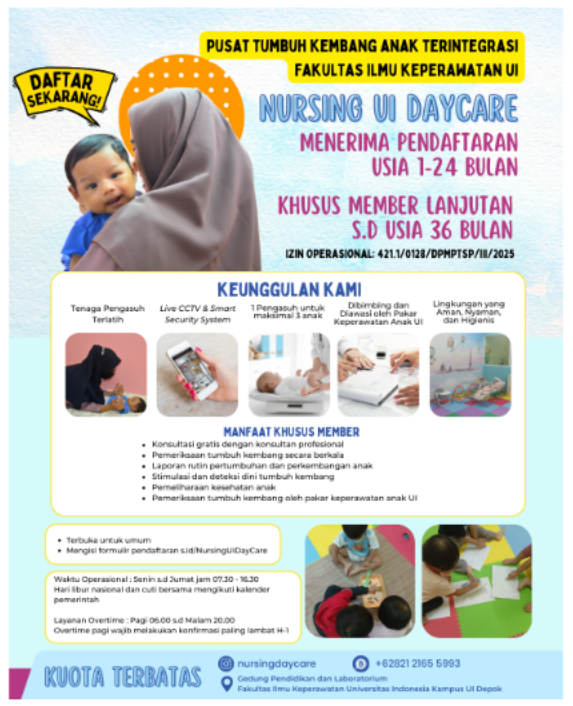
Other than TPAM, UI also has the Nursing UI Daycare, run by FIK UI, which offers childcare services to members of the UI academic community and the general public. Nursing UI Daycare holds Operational Permit No. 421.1/0128/DPMPTSP/III/2025. The service accepts new children aged 1–24 months, with enrolment extendable until the age of 36 months.

Nursing UI Daycare Flyer

Other Supporting Facilities

To further support the women of UI’s community, we provide private nursing rooms in many buildings across UI. Nursing rooms are equipped with recliners, tables, and refrigerators, as well as partitions for privacy so mothers are able to comfortably pump and store breast milk in the room. Through the provision of these facilities, UI hopes to support student and working mothers to fulfil their roles both as a parent and as a student or working woman.

UI Tracks Women’s Graduation Rates Across Academic Programs to Ensure Educational Equity

UI systematically measures and tracks the graduation rates of female students compared to their male peers across all degree levels in support of SDG 5. Grounded in the belief that educational equity extends beyond inclusive admissions to academic completion, UI conducts systematic data audits to evaluate student progression, identify potential gender gaps, and refine academic support schemes. Comprehensive tracking of student graduation performance in 2025 highlights strong academic outcomes for female scholars, who represent 56.26% of the total 16,281 graduates:

  • Undergraduate & Professional Programs: Female students demonstrate high graduation efficiency, accounting for 57.87% of early graduates and 54.92% of on-time graduates. Conversely, male students represent a slightly higher proportion of late graduates, reaching 54.20%.

  • Master’s & Specialist 1 Programs: Female students maintain higher completion rates in early and on-time categories, comprising 67.52% of early graduates and 61.97% of on-time graduates.

  • Doctoral & Specialist 2 Programs: Female doctoral candidates lead in early completion, representing 53.85% compared to males who amount to 45.95%.

Empirical data from 2025 reveals no systemic gender disadvantage against female students at UI, with women consistently achieving high early and on-time graduation rates. Based on these data-driven insights, UI maintains our existing academic mentorship, financial assistance, and student welfare schemes while continuously monitoring student success to ensure equitable learning environments for all.

UI Guarantees Anti-Retaliation and Whistleblower Protection Against Educational and Employment Disadvantage

In ensuring our commitment to equality and fairness, UI acknowledges the need for a policy protecting those who report educational and employment discrimination. At UI, reports against discriminatory acts are made through SIPDUGA UI, the Reporting System for Alleged Violations at UI, which was launched in 2018. This reporting mechanism covers actions suspected of violating the UI code of ethics, internal regulations, or statutory law and applies to all members of the UI community including students, lecturers, educational staff, and researchers. The system is designed to protect integrity, transparency, and accountability on campus. Reportable actions include plagiarism; forgery or manipulation of academic documents; corruption, collusion, and nepotism; theft; damage to Universitas Indonesia facilities; gratification; abuse of authority or position; conflict of interest; financial manipulation; occupational health and safety violations; sexual harassment or indecency; sexual violence; violations of other codes of ethics and conduct; violations of employee discipline; violations of other internal regulations; violations of statutory laws and regulations.

Through SIPDUGA, confidentiality and protections are guaranteed. The reporter’s identity and the report contents are kept confidential and known only to the receiving teams, and anyone managing SIPDUGA is prohibited from interfering with that confidentiality. UI guarantees protection from unfair dismissal; demotion or reduction in rank; harassment or discrimination; bullying; and adverse entries in the individual’s personal records. Legal basis for SIPDUGA includes Rector’s Regulation No. 59 of 2022 on the Mechanism for Imposing Sanctions; Rector’s Regulation No. 36 of 2022 on the Reporting System for Alleged Violations; Rector’s Regulation No. 91 of 2022 on the Prevention and Handling of Sexual Violence; Rector’s Regulation No. 60 of 2022 on the Mechanism for Imposing Sanctions; Rector’s Regulation No. 4 of 2024 on the Code of Ethics and Code of Conduct; and Circular Letter No. 02 of 2024 on the Implementation of the Program for Prevention and Handling of Sexual Violence.

SIPDUGA UI Launch Ceremony
SIPDUGA UI Website

UI Enforces Paternity Leave Policies to Support Shared Childcare Duties and Female Workplace Participation

As an extension to our maternity policy, UI also implements paternity leave as outlined by the UI Rector’s Regulation No. 45 of 2025 on the Management of Resources, as well as in national constitution, namely Constitution No. 4 of 2024 on the Welfare of Mothers and Children in the First Thousand Days of Life. Non-gestational parents are entitled to accompanying leave upon their spouse giving birth, a miscarriage, and/or other special cases relating to the well-being of the mother or the child. By guaranteeing paternity leave rights, UI fosters a shared parenting culture that ensures female staff and researchers are supported at home, directly advancing women’s career progression and workplace retention across all academic disciplines.

UI's SDG 5 Report

PubHTML5 LightBox Embed Demo