Our actions and goals
Click the SDG Goals to read the initiatives

















SDG 8: Decent Work and Economic Growth
Promote sustained, inclusive and sustainable economic growth, full and productive employment and decent work for all
UI Ensures Staff and Faculty Are Paid a Living Wage
Universitas Indonesia (UI) pays all staff and faculty at least the local defined living wage, as defined in Clause 69 of the UI Rector’s Regulation No. 45 of 2025 on the Management of Resources. The total take-home pay (THP) for UI’s staff includes their basic salary and various allowances, including food, transport, attendance incentives, and overtime which is guaranteed to meet or exceed the legal threshold, as defined by the regional government as the Minimum Regional Wage (UMR) of Depok. This clause also mentions that an employee’s pay is determined based on the principles of pay for person, pay for position, and pay for performance. Expanding on the principle of pay for person, the UI Rector’s Decree No. 264 of 2014 on the Salary and Welfare Regulations for Permanent UI Employees defines the criteria taken into consideration in determining pay, namely marriage status in which married employees receive a spousal allowance, and children in which employees with children under their care receive an allowance for child support.
In addition to their THP, staff with both permanent and non-permanent contracts receive vouchers with their holiday allowance on certain religious holidays, as well as biannual performance-based incentives. This incentive program was launched in 2025 and is based on individual performance and organizational performance.
UI Recognizes Unions for All
UI recognizes the many organizations and unions that represent the interests of our staff and faculty. The following are several active organizations and unions at UI:
Paguyuban Pekerja (PP) UI is a labor union organization registered in 2010 under the name of the UI Workers Union, which later changed its name to PPUI in 2012. PPUI is independent, democratic, scientific, and accountable; and its membership does not discriminate based on ethnicity, religion, race, gender, disability, or political affiliation. PPUI itself is not affiliated with any political party. PPUI welcomes all walks of UI employees, including but not limited to permanent and non-permanent staff, faculty, laboratory technicians, laboratory and teaching assistants, and interns. Since their establishment, PPUI has represented the interests of workers at UI, advocated for workers’ rights through various channels, and conducted various focus group discussions to best represent the workers’ interests.
Dewan Guru Besar (DGB) UI is an association of UI’s professors committed to strengthening the strategic role of professors as guardians of academic values, drivers of knowledge, and providers of tangible contributions to society. In facing the increasingly complex challenges of our time, professors are expected to be present not only in the academic sphere but also to play an active role in generating ideas, research, and innovations with broad impact. By strengthening policy innovation, collaboration with industry, and knowledge-based contributions to society, DGB UI encourages professors’ scientific capacity to become the basis for strategic solutions for the Indonesian nation.
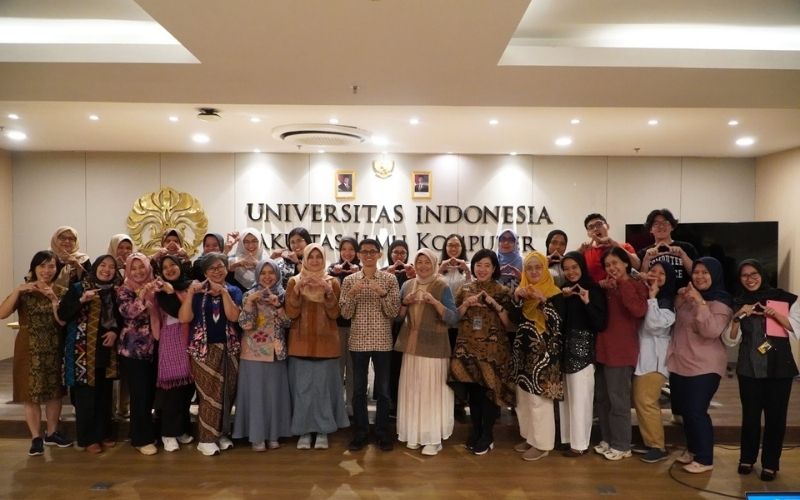
Ikatan Wanita Keluarga (IWK) UI is an association for women at UI which has chapters in every faculty and school at UI. IWK UI implements various work programs to support the welfare of women and families of employees at UI, as well as UI students and the surrounding community. IWK UI programs among others include the Jumat Berkah program where IWK distributes free food coupons for students staying at the UI Dormitory; scholarships for the children of UI staff; IWK UI Bazaar that provided a space for small businesses run by the UI community to sell their products; free health screenings in collaboration with external parties; as well as various training and development programs for women at UI and the surrounding community. The following are several examples of those programs held throughout 2025:


UI’s Policy Against Discrimination in the Workplace
UI’s policy on discrimination in the workplace is outlined in the UI Rector’s Regulation No. 45 of 2025 on the Management of Resources, which is an update on the UI Rector’s Regulation No. 33 of 2018, derived from national regulations. Policies on pay and career advancement at UI are based on career level and performance as opposed to personal characteristics. Clause 55 dictates that every employee who meets the requirements has the same right to be promoted to a higher level position; and that employee promotions are carried out objectively and transparently by taking into account the competencies, qualifications and requirements required by the available positions, without differentiating between gender, ethnicity, religion, race and social class.
Building on the Government Regulation No. 75 of 2021 on the Statute of Universitas Indonesia and the UI Rector’s Regulation No. 4 of 2024 on the Code of Ethics and the Code of Conduct, UI’s human resource management policies reflect a merit-based framework that upholds equal treatment in recruitment, promotion, and compensation. These measures ensure that gender, age, religion, sexual orientation, or refugee status are never factors in employment decisions.
UI’s Policy Against Forced Labor, Modern Slavery, Human Trafficking, and Child Labor
The UI Rector’s Regulation No. 45 of 2025 on the Management of Resources, updated from the UI Rector’s Regulation No. 33 of 2018, emphasizes lawful and ethical treatment of all UI’s workers. The regulation details the rights of UI employees in Chapter VII on Remuneration and Welfare and Chapter XII on Rights and Obligations. Rights defined in Chapter VII include a livable wage, benefits, incentives, and allowances, as well as protection. UI provides protection for employees against workplace hazards and risks; and/or bullying and sexual harassment. Protection employees are entitled to receive from UI include social security, legal assistance, psychological assistance, and additional assistance if needed. Meanwhile Chapter XII includes employee rights to receive salary, allowances, incentives, and benefits in accordance with regulations; receive leave; have a career path and position; obtain opportunities for competency development; receive protection; receive pension insurance; provide advice to management for the advancement of the work unit and/or UI; and submit a retirement preparation period one year before retirement.
In regards to explicit policies against forced labor, modern slavery, human trafficking, and child labor, UI abides by the constitution and laws set by the Indonesian Government, namely Constitution No. 20 of 1999 on the Ratification of the ILO Convention No. 138 Concerning Minimum Age for Admission to Employment. Additionally, UI also implements a minimum age requirement in hiring by requiring all employees to have at least obtained a bachelor’s degree.
UI Guarantees Equivalent Rights for Outsourced Workers
In addition to the UI Rector’s Regulation No. 45 of 2025 on the Management of Resources, updated from the UI Rector’s Regulation No. 33 of 2018, UI ensures that outsourced workers receive their legal rights by holding the service provider accountable in fulfilling their workers’ rights via a legally binding contract. Although contracts differ based on the type and length of service being provided, UI includes clauses on workers’ rights in all of them, among others including:
- Service providers are required to provide a living wage in accordance with the Depok City minimum wage.
- Service providers are required to pay salaries no later than the 1st of each month and submit proof of transfer to UI during the monthly report.
- Service providers are required to pay holiday allowances no later than 10 days before the religious holiday.
- Service providers are required to pay health insurance fees, including BPJS Ketenagakerjaan and BPJS Kesehatan.
- Service providers are required to provide coverage for workers experiencing health problems if and/or while their health insurance card cannot be used.
The inclusion of these clauses in contracts ensures that outsourced workers’ rights are consistently fulfilled by the company providing their services.
UI’s Policies on Tracking Gender Pay Equity and Elimination of Gender Pay Gaps
UI’s pay and promotion system is grounded in defined classes and performance metrics that mirror civil‑service rules, and these mechanisms do not take gender into account in determining what class an employee falls under. Through standardized procedures, functional position promotions as well as employee rank and class progressions are based on set, objective criteria, therefore supporting gender equity in pay.
While UI has many policies to define remuneration and welfare for various faculty and employee classes, UI’s main regulation committing to the elimination of gender pay gaps is the UI Rector’s Regulation No. 45 of 2025 on the Management of Resources, which was updated from the UI Rector’s Regulation No. 33 of 2018. More detailed policies among others is the UI Rector’s Decree No. 264 of 2014 on the Salary and Welfare Regulations for Permanent UI Employees which defines the criteria taken into consideration in determining pay.
Additionally, considering a senior and/or managerial position is one of the main considerations in receiving a pay increase, UI takes care to ensure women are equally represented in UI’s senior leadership line up.
UI’s Process for Appeals on Employee Rights and Pay
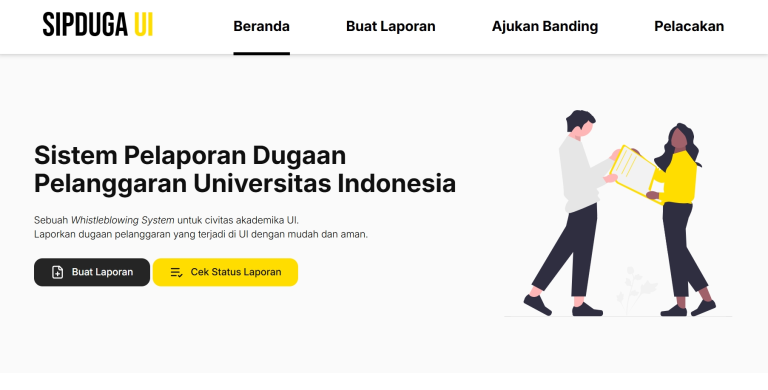
UI has two main channels for UI employees to appeal on employee rights and/or pay. Employees can either appeal through UI’s centralized whistleblowing system, SIPDUGA (Sistem Pelaporan Dugaan Pelanggaran) UI which was monitored by UI’s Directorate for Internal Audit (DAI), or by letter to the Directorate for Human Resources and Talent Development (DSDMPT).
Through SIPDUGA UI, UI guarantees the confidentiality of the appellant’s identity and the contents of the report. The appellant’s information and identity are known only to the teams receiving the report. Moreover, UI ensures protection for employees who appeal against unfair dismissal, demotion, harassment or discrimination, bullying, and detrimental records in the person’s personal data. Employees who elect to appeal directly to DSDMPT are guaranteed the same discretion.
UI Recognizes Labor Rights for All
In the interest of upholding legal protection and social justice for our employees, UI recognizes labor rights for all employees at UI. Labor rights include the right to organize (freedom of association), the right to collective bargaining, non-discrimination in employment, as well as elimination of forced and child labor. As elaborated in earlier sections, UI has policies in place that guarantee non-discrimination and abides by governmental regulations that support the elimination of forced and child labor. UI ensures employees have the right to collective bargaining by providing channels and access for employees to report violations and appeal to employment decisions, whether individually or collectively. Any appeal and/or report employees make through this channel are guaranteed privacy and protection. Additionally, UI does not put any restrictions on our employees to organize nor does UI implement any sanctions on employees who organize. For associations where it is allowed, UI often supports and provides spaces for our employee’s associations to conduct their activities as elaborated in previous sections.
UI's SDG 8 Report