Our actions and goals
Click the SDG Goals to read the initiatives

SDG 12: Responsible Consumption and Production
Ensure sustainable consumption and production patterns
UI Enacts Sustainable Procurement Framework and Ethical Food Sourcing Policies
Universitas Indonesia (UI) strictly enforces an institutional policy framework governing the ethical and sustainable sourcing of food, goods, and campus supplies under Sustainable Development Goal 12 (Responsible Consumption and Production). Governed by university-wide executive regulations, UI mandates that all supply chains prioritize environmental sustainability, product safety, certified eco-friendly materials, and social responsibility across all academic and administrative units.
Institutional Framework for Sustainable Procurement
UI’s sustainable supply chain governance is anchored in formal executive regulations that mandate ethical principles across all university procurement:
- Sustainable Procurement Mandate: Enacted under UI Rectoral Regulation No. 4 of 2022 concerning the Procedure for the Procurement of Goods/Services, UI explicitly requires that all campus procurement activities for goods, services, and operational supplies adhere to strict ethical, environmental, and social criteria. The policy prioritizes suppliers providing environmentally certified products and eco-labeled materials.
Targeted Policy on Ethical and Safe Food Sourcing
UI continually updates and reinforces its ethical supply policies, with a specialized focus on food safety, health, and sustainable packaging:
- Regulation on Hazardous Food Packaging: Reviewed and reinforced under UI Rector Decree No. 439 of 2024 concerning Restrictions on Food and Beverage Packaging Containing Hazardous and Toxic Substances (B3), UI prohibits campus vendors and caterers from supplying food packaged in hazardous materials.
- Health and Environmental Protection: The directive forces campus food suppliers to transition to eco-friendly, biodegradable, and non-toxic alternatives. This ensures that food supplies served to students, faculty, and staff meet high safety standards while actively eliminating single-use hazardous plastic and B3 contaminants across campus canteens and events.
Through comprehensive procurement rules and strict food supply safety standards, UI that its institutional consumption remains ethically sourced and environmentally responsible.
Furthermore, UI reinforces its commitment to responsible food procurement through concerning Restrictions on Food and Beverage Packaging Containing Hazardous and Toxic Substances (B3) across the UI campus. This policy was issued to protect human health and support environmental conservation within the green campus by restricting food and beverage packaging containing hazardous and toxic substances and encouraging the use of environmentally friendly packaging alternatives.
Policy on Hazardous Waste Management
UI has established a formal policy on hazardous waste management through the UI Rectoral Decree No. 1213 of 2024 concerning the Policy on the Management of Waste and Waste Containing Hazardous and Toxic Materials (B3) within Universitas Indonesia. This policy explicitly mandates the management of B3 waste generated from both academic and non-academic activities. This Rectoral Regulation was stipulated on July 22, 2024. This decree officially revokes the previous UI Rectoral Decree (No. 1305 of 2011), confirming a significant policy update in 2024.
Policy on Waste Disposal
UI maintains a formal waste disposal policy that requires the systematic measurement of waste sent to landfill and the amount recycled, making quantitative tracking an institutional obligation. This commitment is embedded in the Universitas Indonesia Green Campus Policy established by Rector’s Decree No. 2893/SK/R/UI/2018, which frames waste reduction and resource recovery as core elements of campus sustainability and aligns campus practice with sustainable development.
The Green Campus Policy was reviewed and strengthened in 2024 through Rector’s Decree No. 438 of 2024 on Universitas Indonesia Green Sustainable Campus Policy, as well as subsequent decrees on waste management that explicitly mandates quantitative waste tracking across campus operations. The strengthened policy ensures that landfill diversion and recycling rates are routinely measured, recorded, and reported, and it positions measurement as the basis for target‑setting and performance assessment. Operationally, the policy is translated into procedures for waste segregation, data collection at building and facility levels, centralized reporting by the Directorate for Facilities and Sustainability, and periodic audits to verify landfill and recycling figures. These processes enable the university to calculate landfill diversion, monitor trends in waste generation, and identify opportunities to increase recycling and reduce residual waste through procurement, behavior change campaigns, and infrastructure improvements.
This policy establishes quantitative waste tracking as an institutional requirement. Waste management begins at the points where waste is generated, such as faculties, units, or administrative offices. More than 50% of the waste generated across the UI campus consists of organic waste. Of this amount, approximately 90% is processed through Waste Processing Units (Unit Pengolahan Sampah/UPS) at the faculty level.
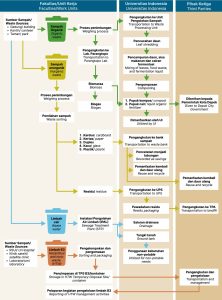
By codifying measurement and reporting, Universitas Indonesia links strategic sustainable development commitments to everyday operations, ensuring that waste management is data‑driven, transparent, and accountable.
UI Enacts Reviewed Policies to Eliminate Single-Use Plastics and Minimize Plastic Consumption Campus-Wide
UI strictly enforces comprehensive institutional policies to minimize plastic consumption and eliminate single-use plastics under Sustainable Development Goal 12 (Responsible Consumption and Production). Governed by university-wide executive regulations, UI mandates that all academic activities, administrative offices, campus canteens, vendors, and events adhere to strict plastic minimization standards to promote a zero-waste campus environment.
Institutional Framework and Evolution of Plastic Minimization Policies
UI’s commitment to minimizing plastic waste is rooted in a clear trajectory of institutional policy creation and review:
- Initial Policy Creation (2011 & 2019): UI initiated its reduction framework under Rector Decree No. 1308/R/UI/SK/2011 regarding Paper and Plastic Consumption Reduction. This was formally institutionalized into a binding university mandate via UI Rector Regulation No. 4 of 2019 concerning the Zero Plastic Program, which strictly banned single-use plastic bags, straws, disposable tableware, and single-use bottled water across all campus facilities.
- Policy Review & Extension (2024): UI formally reviewed and expanded its plastic minimization mandate through UI Rector Decree No. 439 of 2024. This updated decree accelerates the transition from plastic packaging to biodegradable, environmentally friendly, and recyclable food and beverage packaging alternatives across all campus operations.
Comprehensive Implementation and Campus-Wide Enforcement
The plastic minimization policy imposes clear operational obligations across the university community:
- Universal Scope: Mandatory compliance applies to all students, faculty members, administrative staff, contractors, campus canteens, and external event organizers.
- Refill & Eco-Packaging Culture: UI facilitates plastic reduction by promoting reusable water containers, installing drinking water refill stations, and mandating that campus canteens substitute single-use plastic wraps with non-toxic, eco-friendly materials.
Through continuous policy updates, binding zero-plastic regulations, and eco-friendly packaging mandates, Universitas Indonesia maintains standard practices for plastic minimization.
UI Extends Sustainability and Waste Minimization Policies to Outsourced Services and Supply Chains
UI mandates that its environmental sustainability, waste management, and single-use item minimization policies extend to all external contractors, outsourced service providers, and procurement supply chains under Sustainable Development Goal 12 (Responsible Consumption and Production). Governed by binding university-wide procurement regulations, UI ensures that third-party vendors collaborating with the university strictly adhere to sustainable operating practices.
Institutional Procurement Framework and External Scope Extension
UI’s extension of sustainability mandates to external supply chains is codified through formal executive procurement regulations:
- Binding Regulation for Third Parties: Enacted under UI Rectoral Regulation No. 4 of 2022 concerning the Procedure for the Procurement of Goods/Services, UI explicitly integrates ethical, social, and environmental compliance into all university-funded procurement workflows.
- Coverage of Outsourced Services & Supply Chains: The regulation legally binds all external service providers—including campus security, janitorial and cleaning services, catering contractors, building construction firms, and logistics vendors—making sustainability compliance a core contractual obligation.
Contractual Mandates and Operational Standards
Under UI’s Sustainable Procurement Policy, third-party contractors must integrate waste reduction and environmental management directly into their daily operations:
- Contractual Sustainability Clauses: All vendors entering into agreements with UI must contractually comply with university waste segregation standards, hazardous waste (B3) handling rules, and single-use plastic minimization directives (e.g., banning disposable packaging and plastic tableware across campus catering).
- Vendor Accountability & Monitoring: Compliance with these green procurement criteria forms a prerequisite for vendor qualification, performance evaluation, and contract renewal.
Through legally binding procurement rules and public policy transparency, Universitas Indonesia guarantees that its sustainability standards govern both internal operations and external supply chains.
UI Extends Sustainable Procurement Policies to Equipment Suppliers, Stationery Vendors, and Building Contractors
UI strictly mandates that its environmental sustainability, eco-labeling, and waste reduction policies extend across all physical supply chains—specifically targeting suppliers of equipment, stationery vendors, and building construction contractors under Sustainable Development Goal 12 (Responsible Consumption and Production). Governed by binding executive procurement directives, UI ensures that external vendors supplying goods and infrastructure services adhere to strict green criteria as a prerequisite for university contracts.
Comprehensive Procurement Scope and Vendor Obligations
UI’s Sustainable Procurement Policy enforces legally binding sustainability standards tailored to key procurement categories:
- Governance Framework: Enacted under UI Rectoral Regulation No. 4 of 2022 concerning the Procedure for the Procurement of Goods/Services, UI embeds environmental, social, and ethical requirements into all university tender procedures and supply agreements.
- Suppliers of Equipment: Manufacturers and vendors supplying laboratory apparatus, IT hardware, and operational machinery must comply with energy efficiency standards, hazardous substance restrictions, and eco-certification criteria.
- Suppliers of Stationery: Vendors providing office supplies and stationery must adhere to UI’s paper reduction mandates (SK Rektor No. 1308/2011) and zero-plastic policies, prioritizing FSC-certified recycled paper and non-toxic office materials.
- Building & Infrastructure Contracts: General contractors executing campus construction or building renovation projects are contractually bound to implement green building practices, proper construction waste disposal, hazardous material (B3) containment, and GBCI/EDGE sustainability guidelines.
Contractual Verification and Supply Chain Accountability
UI ensures that green procurement rules are actively enforced throughout contract lifecycles:
- Prerequisite Qualification: Environmental compliance forms a mandatory scoring metric during vendor qualification, technical evaluation, and contract drafting.
- Public Transparency: The policy and compliance frameworks are publicly accessible via UI’s official procurement portal (https://logistik.ui.ac.id/sustainable-procurement-policy/), ensuring transparency and third-party auditability.
Through legally binding procurement regulations, Universitas Indonesia ensures that equipment, stationery, and building contracts operate in alignment with institutional sustainability standards.
UI Implements Whole-University Waste Measurement Framework, Tracking 905 Tons of Campus Waste
- Whole-University Coverage: Data collection systematically encompasses all 17 faculties, central administrative offices, and operational units across both UI campuses.
- Verified Annual Waste Metrics: According to UI’s official campus waste recapitulation, total recorded campus waste generated reached 905 metric tons.
- Landfill Diversion & Recycling Performance: Out of the total waste generated, 718 metric tons of waste were successfully recycled and processed through on-site facility recovery systems, leaving only 187 metric tons of residual waste sent to landfills.

Through verified whole-university measurement protocols, decentralized processing at Waste Processing Units (UPS), and transparent data tables, Universitas Indonesia ensures that its campus waste and recycling management remains accountable, transparent, and data-driven.
UI's SDG 12 Report