Our actions and goals
Click the SDG Goals to read the initiatives

SDG 13: Climate Action
Take urgent action to combat climate change and its impacts
Universitas Indonesia Demonstrates Whole-University Low-Carbon Energy Tracking Across Campus Units
Universitas Indonesia (UI) strictly measures and tracks its low-carbon energy consumption and generation metrics across all campus facilities under Sustainable Development Goal 7 (Affordable and Clean Energy) and Sustainable Development Goal 13 (Climate Action). Managed centrally by the Directorate of Operations and Facility Maintenance (DOPFMA UI), the university maintains a verified data monitoring system that tracks total energy usage (in GJ) alongside multi-source renewable energy expansion across 18 faculties and operational units.
- Total Campus Energy Consumption: UI recorded total energy usage of 96,076 GJ in 2023, which expanded to 151,241 GJ in 2024, and was efficiently managed at 150,677 GJ in 2025.
- Low-Carbon Energy Generation: Energy sourced from low-carbon installations grew steadily from 8,647 GJ in 2023 to 13,154 GJ in 2024, reaching 14,338 GJ in 2025 (a 65.8% increase compared to the 2023 baseline). Low-carbon energy accounted for 9.52% of the university’s total energy consumption in 2025.
Climate Change Education, Mitigation, and Adaptation Initiatives
UI actively supports climate change education and awareness through various programmes and campaigns targeting our academic community and the wider public. hese initiatives include community engagement programmes, academic discussions, and other educational activities, as outlined below:
SAHABAT UI
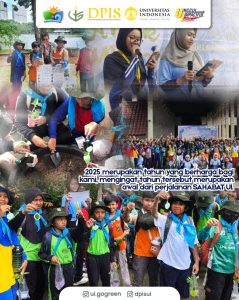
The SAHABAT UI Program was first initiated in 2025 as a platform for UI student delegates to educate local communities about climate change while encouraging young people to take tangible action. In its inaugural year, the programme reached more than 600 elementary, junior high, and senior high school students across the Greater Jakarta area (Jabodetabek) through various activities, including roadshows, treasure hunts, and mangrove campaigns. The programme also established 58 Climate Change Ambassadors, who help expand the reach of climate education and raise public awareness of climate change. Through this initiative, UI provides opportunities for young people to understand the climate crisis, participate in environmental activities, and contribute to collective climate action.
Integrating Climate Change Issues into Education at UI
Faculty of Nursing (FIK) UI, introduced the Nursing Perspective on Climate Change (NPCC) course to prepare future nurses who are adaptive, resilient, and responsive to the health impacts of climate change.
As a pioneer in nursing education in Indonesia, the NPCC program has been implemented since 2022 and has gained international recognition through the publication of the article “Integrating Climate Change Education in Pre-Registration Nursing Degree in Indonesia: A Case Study” in Nurse Education Today (Q1). The introduction of the NPCC course reflects FIK UI’s commitment to strengthening the education and capacity of healthcare professionals to address climate change.

Disaster Resilience and Ecological Education through the 2025 Eco-Resilience Project
Together with the Center for Disaster Risk Mapping and Mitigation Studies (SPPB UI), UI strengthens community resilience to the impacts of climate change through the 2025 Eco-Resilience Project in Parakansalak Village, Sukabumi Regency, West Java. The programme includes disaster mitigation and preparedness training for local communities. Through these activities, UI contributes to strengthening community adaptive capacity in responding to hydrometeorological disaster risks while enhancing ecological literacy. This initiative also promotes greater public awareness and capacity to understand and implement climate change mitigation and adaptation measures sustainably.
Panel Discussion on Carbon Emission Reduction
UI collaborated with Carbon Sustain 4 Good (CS4G) and the National University of Singapore to organize a panel discussion titled “Sustainability Day: Sustaining Carbon, Sustaining Life” on October 8, 2025. The event provided a platform for discussion and education on carbon emissions and climate change from both local and international perspectives. Through this collaboration, participants had the opportunity to discuss various efforts and plans to reduce carbon emissions as part of climate change mitigation.
CAGAR Action Movement
Through students from the Faculty of Nursing and the Vocational Education Program,, UI conducted a community engagement initiative focused on educating local communities and developing mitigation measures to address the health impacts of climate change. The activity involved 37 participants, including health cadres, village officials, community leaders, and youth representatives from the Karang Taruna community organization. This initiative represents an implementation of climate education by the Faculty of Nursing UI to strengthen awareness and preparedness in addressing health risks associated with climate change.
UI Shares Institutional Climate Action Framework and Collaborative Strategies with Local Governments and Communities
UI advances Sustainable Development Goal 13 (Climate Action) by aligning its formal institutional Climate Action Plan and Green Campus policies with local governments and regional community groups. Guided by UI Rector Decree No. 438 of 2024 concerning the Sustainable Green Campus Policy and the university’s Climate Resilience Roadmap, UI actively shares, operationalizes, and executes climate adaptation and mitigation strategies through formal partnerships with municipal agencies, healthcare bodies, and community organizations across West Java and Banten.
Sharing Climate Action Plans Through Regional Coastal Rehabilitation
UI translates its institutional climate adaptation plan into shared regional action through strategic government partnerships:
- Pentahelix Collaboration in Cirebon: In 2025, the UI Vocational Education Program formally partnered with the Cirebon City Environmental Agency (Dinas Lingkungan Hidup / DLH Kota Cirebon) to execute mangrove ecosystem rehabilitation using the mound method (metode guludan) along the Kesenden Beach coastline.
- Shared Educational Framework: By sharing UI’s climate mitigation guidelines with local officials, primary schools, and secondary schools across Cirebon City, the initiative established a shared platform for coastal protection, carbon sequestration, and youth environmental literacy.

Disaster Preparedness and Climate Health Resilience Alignment
UI shares its climate adaptation protocols with regional healthcare networks to strengthen local emergency response systems:
- Tangerang Regional Partnership: The Faculty of Medicine (FK UI), in direct collaboration with the Tangerang District Health Office and Regional General Hospital (RSUD), operationalized UI’s climate health resilience frameworks through targeted Disaster Mitigation Training.
- Capacity Building for Local Health Workforce: Conducted on July 23, 2024, the program trained 47 healthcare professionals across 22 community health centers (Puskesmas) and 7 regional hospitals in mass casualty management, triage, and evacuation procedures to withstand climate-induced hydrometeorological emergencies.
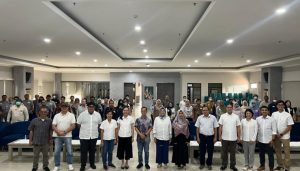
Through shared policy frameworks, joint coastal rehabilitation, and municipal health alignment, Universitas Indonesia guarantees that its Climate Action Plan actively drives regional resilience.
Collaborative Initiatives for Climate-Related Disaster Risk Planning and Reduction
UI contributes to disaster risk planning and reduction through collaboration with government institutions, higher education institutions, and local communities. These efforts involve joint studies, the development of disaster response recommendations, and initiatives to strengthen community capacity in addressing the impacts of climate change. Several collaborative initiatives implemented in 2025 include:
- UI Deploys Response Team for Post-Flash Flood Relief in West Sumatra
Through its Disaster Risk Reduction Center (DRRC), UI collaborated with Padang State Polytechnic (PNP) in post-disaster response efforts following flash floods in West Sumatra. UI’s expert team conducted field assessments in several affected areas of Tanah Datar Regency, including identifying community needs, distributing relief assistance, and conducting geological assessments to prevent further disasters. Based on the findings of the Rapid Health Assessment (RHA) and assessments of flood control infrastructure and slope conditions in affected areas, the team formulated recommendations to support subsequent response efforts and disaster risk reduction. These assessment findings also served as a basis for developing policy recommendations on disaster risk reduction at the local level.
- Collaboration with the Bekasi Regency Government on Tidal Flood Mitigation
UI conducted a community engagement programme in collaboration with the Muaragembong Subdistrict Government, Bekasi Regency, to strengthen local communities’ capacity to address the risks of tidal flooding and drought. Held in September 2025, the programme featured educational sessions and training on rainwater harvesting as an alternative source of clean water, domestic and vessel waste management, and measures to mitigate tidal flooding. This collaboration facilitated the transfer of knowledge and technology while strengthening the involvement of local government and communities in reducing disaster risks in coastal areas.
- Collaborative Limnological and Hydrological Research with BRIN for Climate Change Adaptation
Through DRRC UI, UI established a collaboration with the National Research and Innovation Agency (BRIN) to develop limnological and hydrological research aimed at anticipating the impacts of climate change. The 18-month collaboration focuses on developing an Internet of Things (IoT)-based freshwater conservation model in drought-prone areas of Kulon Progo, Yogyakarta. The scope of the collaboration includes joint research, community training, and technological development involving reservoir rehabilitation, solar-powered drip irrigation systems, and the use of soil moisture and weather sensors to support efficient water distribution.
- UI and Greenpeace Indonesia on Green Waqf Development as an Alternative Climate Action Financing Mechanism
UI, through the Center for Islamic Economics and Business at the Faculty of Economics and Business (PEBS FEB UI), collaborated with Greenpeace Indonesia on a study titled “From Endowment to Environment: Empowering Waqf for Climate Change Action and Resilience”. This collaboration addressed funding challenges in supporting the achievement of Indonesia’s climate action commitments. Through this study, UI contributed to promoting the development of green waqf as an alternative financing instrument for climate action.
Collaborate with NGOs on Climate Adaptation

As part of efforts to formulate financing strategies in support of Indonesia’s climate action commitments, Universitas Indonesia (UI) collaborated with Greenpeace Indonesia on a study entitled “From Endowment to Environment: Empowering Waqf for Climate Change Action and Resilience.” The study promotes the development of green waqf as an alternative financing instrument for climate action. The resulting policy brief identifies Indonesia’s waqf economic potential, estimated at IDR 400 trillion annually, which could be optimized to support various sustainable projects, including reforestation, renewable energy, water resource conservation, and sustainable agriculture.
Dr. Banu Muhammad, Founder of the Indonesian Productive Waqf Foundation and Senior Researcher at PEBS FEB UI, advocates the development of the Public–Private Waqf Partnership (PPWP) as a collaborative model to expand the inclusive socio-economic impact of green financing. PEBS FEB UI also recommends a pentahelix approach to ensure that green waqf initiatives are developed in a more structured manner and can be replicated across different regions.
The policy brief outlines several strategic recommendations, including strengthening and harmonizing regulations; improving institutional governance; developing human resources and research; formulating a national green waqf literacy strategy; strengthening the implementation of green waqf initiatives; optimizing and innovating green waqf financing models; and strengthening the green waqf ecosystem through multi-stakeholder collaboration.
UI Commits to Achieving Carbon Neutrality
- Institutional Commitment & Governance: UI has set 2060 as its baseline target date for net-zero emissions. Overseen by UI-NZI, this target serves as an operational benchmark that will be continuously accelerated as campus-wide renewable installations and efficiency upgrades expand.
- GHG Protocol Scope Alignment: UI structures its institutional footprint into clear operational boundaries:
- Scope 1 (Direct Emissions): Consolidation of direct emissions from university-owned vehicles, generators, and on-site fuel combustion across faculties.
- Scope 2 (Purchased Electricity): Comprehensive accounting and active reduction of grid-purchased electricity—the university’s primary emission contributor—through solar PV installations and energy-efficient building infrastructure.
- Scope 3 (Indirect Supply Chain & Commuting Emissions – Partial): Expanding footprint accounting covering paper usage, procurement, water consumption, waste management streams, and campus commuting patterns.
- 2025 Emission Accounting: In direct collaboration with CSWM UI, the university conducts rigorous tracking to monitor emission reduction baselines and track progress against target milestones.
- Operational Decarbonization Pilots: Key campus measures include retrofitting building systems, expanding rooftop solar installations, upgrading campus electric shuttles, and integrating green procurement criteria to lower upstream/downstream Scope 3 impacts.
UI's SDG 13 Report